God Our Refuge (Psalm 46)
Michael Floyd, Editor
God is our refuge and strength, an ever-present help in trouble. Therefore we will not fear, though the earth give way and the mountains fall into the heart of the sea, though its waters roar and foam and the mountains quake with their surging.

There is a river whose streams make glad the city of God, the holy place where the Most High dwells. God is within her, she will not fall; God will help her at break of day. Nations are in uproar, kingdoms fall; he lifts his voice, the earth melts.

The LORD Almighty is with us; the God of Jacob is our fortress.

Come and see what the LORD has done, the desolations he has brought on the earth. He makes wars cease to the ends of the earth. He breaks the bow and shatters the spear; he burns the shields with fire. He says, "Be still, and know that I am God; I will be exalted among the nations, I will be exalted in the earth."

The LORD Almighty is with us; the God of Jacob is our fortress. – Psalm 46
“Be still and know that I am God.” You have probably seen it on a mug or a wall print. It is one of the most quoted verses in the Psalms — and one of the most removed from its setting. Taken alone, it sounds like an invitation to quiet. But the Sons of Korah did not write this psalm for quiet mornings. They wrote it for the day when the mountains are falling into the sea.
When Everything Gives Way
Psalm 46 does not ease into its subject. The opening stanza describes real catastrophe: the earth gives way, mountains collapse, the waters roar and foam. In the ancient world, mountains were what did not move. When the psalmist says they are falling, he means everything seemingly permanent has come undone.
Yet the first word is not “fear.” It is “God.” The “therefore” in verse 2 carries weight. Because of who God is, we will not fear — not “we will calm ourselves, then trust,” but “God is our refuge, therefore we will not fear.” This is not a posture we achieve. It is one we receive.
The River in the City
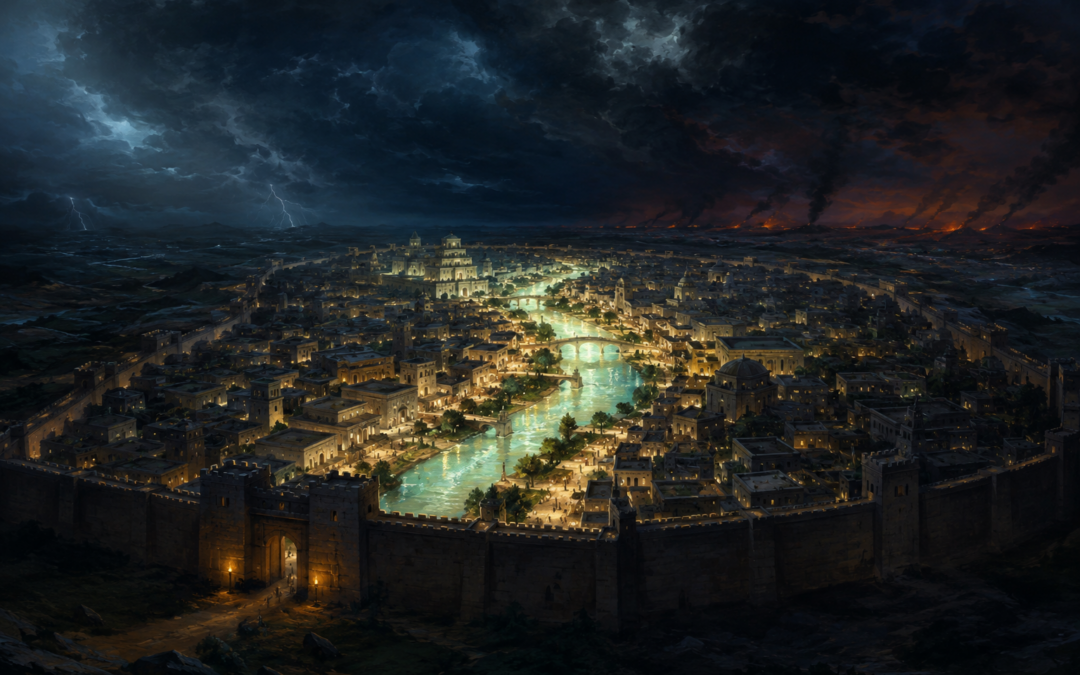
The second stanza sets a stark contrast. Outside, nations rage and kingdoms fall. Inside the city of God, a river flows whose streams bring joy (v. 4). The difference is not geography. It is presence. “God is within her, she will not fall” (v. 5).
The refrain at verse 7 anchors everything: The LORD Almighty is with us; the God of Jacob is our fortress. It returns at verse 11, bracketing the psalm’s final movement. This is the load-bearing claim — not that we will feel peace, but that God is with us. Prayer rooted in this psalm does not begin by achieving stillness. It begins by remembering who is already there.
What “Be Still” Actually Means
Here is where the misreading happens. Verse 10 reads: He says, “Be still, and know that I am God; I will be exalted among the nations, I will be exalted in the earth.”
Notice: He says. God is speaking — and not to people who need to slow their breathing. He is addressing nations. The context is verses 8-9: bows broken, spears shattered, wars brought to an end. The Hebrew verb (raphah) means to let go, release your grip. God is commanding the powers striving against Him: stop. Release your hold. Know who actually rules.
For those who pray, this reframes everything. We are not called to manufacture stillness — we are called to know that God has declared His supremacy over every power that frightens us. Prayer from this psalm does not begin by achieving a particular inner state. It begins with standing where the river flows and saying the refrain: The LORD Almighty is with us.
Jesus and the God Who Holds
When a storm came up on the Sea of Galilee, the disciples panicked. Jesus was asleep. When they woke Him, He spoke to the wind and the waves: “Quiet! Be still!” (Mark 4:39). Their question was genuine: “Who is this? Even the wind and the waves obey him!” They were meeting the God of Psalm 46 in the flesh.
In John 16:33 Jesus told His disciples: “In this world you will have trouble. But take heart! I have overcome the world.” The cross looked like total collapse — and the resurrection proved that the LORD Almighty would be exalted in the earth after all.
Through Christ, we are brought inside the city where the river flows. His Spirit is that river of gladness. When we pray, we turn toward the one already with us — the fortress that holds when everything gives way. We can release our grip, because He has not released His hold on us.
Praying From the Refuge
Psalm 46 does not ask you to feel serene before you pray. It asks you to pray from within the storm, on the foundation that holds when the mountains are falling. The call to “be still” is a call to know — to anchor yourself not in your emotional state but in who God is. He is with you. He is your fortress. His word has gone out: I will be exalted in the earth. That is the ground beneath you, whether the earth is steady or giving way.
Questions for Reflection:
- Psalm 46 grounds its confidence in who God is, not how things look. When trouble comes, where does your prayer tend to begin — with the situation or with God’s character? What would it mean to start with the latter?
- The refrain “The LORD Almighty is with us” appears twice, anchoring the psalm. Is there a truth about God that functions that way in your own prayer life — something you return to when fear rises?
- “Be still” in verse 10 is about releasing the pretense of control, not achieving inner quiet. Is there something you are gripping right now — a situation, a relationship, an outcome — that God may be calling you to release?
- The psalmist prays from inside a threatened city, not from a place of achieved safety. Where in your life does prayer feel hardest right now? What would it mean to pray from that exact place rather than waiting until it resolves?
[Image description and credit: An ancient city at night: storm and chaos surround its walls, while a luminous river flows peacefully through its center. Image generated with ChatGPT.]