Seeking the Face of God (Psalm 27)
Michael Floyd, Editor
The Lord is my light and my salvation—
    whom shall I fear?
The Lord is the stronghold of my life—
    of whom shall I be afraid?

When the wicked advance against me
    to devour me,
it is my enemies and my foes
    who will stumble and fall.
Though an army besiege me,
    my heart will not fear;
though war break out against me,
    even then I will be confident.

One thing I ask from the Lord,
    this only do I seek:
that I may dwell in the house of the Lord
    all the days of my life,
to gaze on the beauty of the Lord
    and to seek him in his temple.
For in the day of trouble
    he will keep me safe in his dwelling;
he will hide me in the shelter of his sacred tent
    and set me high upon a rock.

Then my head will be exalted
    above the enemies who surround me;
at his sacred tent I will sacrifice with shouts of joy;
    I will sing and make music to the Lord.

Hear my voice when I call, Lord;
    be merciful to me and answer me.
My heart says of you, “Seek his face!”
    Your face, Lord, I will seek.
Do not hide your face from me,
    do not turn your servant away in anger;
    you have been my helper.
Do not reject me or forsake me,
    God my Savior.
Though my father and mother forsake me,
    the Lord will receive me.
Teach me your way, Lord;
    lead me in a straight path
    because of my oppressors.
Do not turn me over to the desire of my foes,
    for false witnesses rise up against me,
    spouting malicious accusations.

I remain confident of this:
    I will see the goodness of the Lord
    in the land of the living.
Wait for the Lord;
    be strong and take heart
    and wait for the Lord. – Psalm 27
There’s a difference between hoping things will work out and actually being confident. David wrote Psalm 27 from inside a real threat—enemies advancing, false witnesses making accusations, abandonment pressing in. His confidence wasn’t a disposition; it was a decision rooted in one conviction: “The LORD is my light and my salvation.” That sentence doesn’t describe a feeling. It makes a claim, and everything in this psalm flows from it.
The Ground of Confidence
The psalm opens with two parallel declarations: God is light, God is salvation—therefore, fear loses its logic. “Whom shall I fear?” isn’t rhetorical bluster. It’s theological reasoning. If God is my salvation, no threat can determine my ultimate outcome.
It’s notable that David doesn’t minimize the danger. The wicked do advance. Armies do besiege. He isn’t dismissing these realities; he’s measuring them against a larger one. The LORD is “the stronghold of my life”—a fortress when the battle looks lost.
This matters for prayer. We often approach God most urgently when we’re least confident—when fear is loudest. David shows us a different order: begin with who God is, and let that establish what fear can and cannot do.
The One Thing
Verse 4 is the hingepoint of the psalm. After establishing God’s character and his own fearlessness, David narrows everything to a single request—not safety, not victory. He asks to dwell in the house of the LORD, to gaze on God’s beauty, to seek Him.
This is the heart of prayer: not demanding from God, but wanting God. David’s confidence flows from this. He isn’t approaching God as a vendor of services. He’s approaching God as his home.
The connection to 1 John 5:14 is precise: “This is the confidence we have in approaching God: that if we ask anything according to his will, he hears us.” Praying according to God’s will isn’t a riddle to solve before you can pray boldly—it describes a heart that has sought God’s face and been shaped by it. When we want what God wants, confidence follows. Meager confidence in prayer often signals that we haven’t yet made God Himself our “one thing.”
Seeking His Face
Verse 8 gives us something remarkable: “My heart says of you, ‘Seek his face!’ Your face, Lord, I will seek.” Prayer at this depth is God drawing us toward Himself; the desire to seek is itself a gift.
The psalm’s middle section doesn’t paper over fear or desperation. David prays from inside it: “Do not hide your face from me.” He asks for mercy, for teaching, for a straight path—even as enemies slander him. When circumstances suggest God has withdrawn, David’s posture doesn’t change. He still seeks the Lord’s face.
The psalm ends not with resolution but with instruction: “Wait for the LORD; be strong and take heart.” Confidence in prayer doesn’t always mean quick answers. Sometimes it means holding your position—staying in the posture of seeking when nothing has yet appeared.
Christ, Our Light and Our Confidence
Jesus makes this psalm’s confidence available to us. When David declares, “The LORD is my light,” he anticipates the one who said, “I am the light of the world. Whoever follows me will never walk in darkness” (John 8:12). When David fears being forsaken—even by his own parents—he names a dread that Jesus actually bore on the cross so that we never have to. As Hebrews 13:5 promises: “Never will I leave you; never will I forsake you.”
The “one thing” David sought—dwelling in God’s presence—Jesus secured. We no longer approach God through temple courts and priestly mediation. Because Christ has gone before us, we come with confidence to the throne of grace (Hebrews 4:16).
And 1 John 5:13 makes the ground of that confidence explicit: “I write these things to you who believe in the name of the Son of God so that you may know that you have eternal life.” The basis for bold prayer is not our sincerity—it’s the name of the Son of God. Jesus doesn’t just model David’s confidence. He is the reason we have it.
A Prayer to Seek
Psalm 27 doesn’t leave us with a method. It leaves us with a person—a God worth seeking, worth waiting for, worth making the “one thing” of our prayer lives. If your confidence in prayer has worn thin, it may be that prayer has drifted toward asking without dwelling. Come back to His face. Seek Him as David did—not because you feel confident, but because God is faithful.
Questions for Reflection
- David’s “one thing” was dwelling in God’s presence—not answered prayers, not resolved circumstances. What is the “one thing” you find yourself actually seeking when you pray? What does your answer reveal about where your heart is?
- The psalm moves from confident declaration (vv. 1–3) to raw, urgent petition (vv. 7–12) without embarrassment. Do you find it easier to declare God’s greatness or to bring your actual fears to Him? What creates the gap?
- John writes that we may know we have eternal life—and that knowing grounds our confidence in prayer. How settled is that knowledge for you? Does uncertainty about your standing with God affect how you pray?
- The psalm ends with “Wait for the LORD.” What does active, confident waiting look like for you right now—not passivity, but holding your position in prayer? Where do you need to take heart and keep seeking?
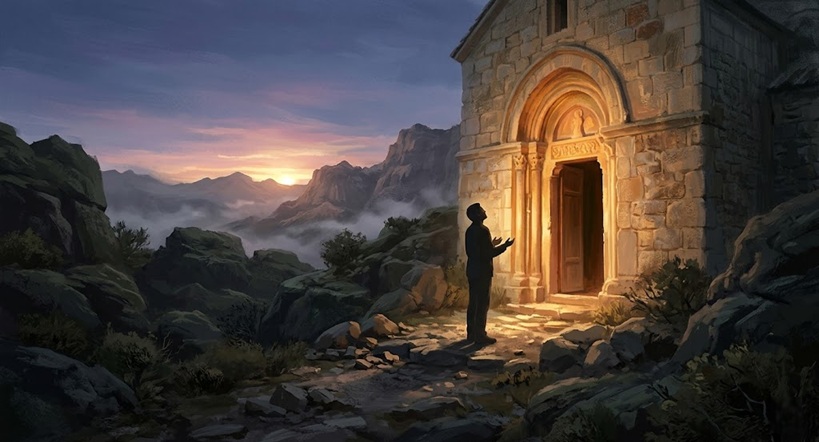
(Image description and credit: A solitary figure approaches a warmly lit stone sanctuary at dawn, hands open, face lifted—surrounded by rocky, shadowed terrain. Image generated by Google Gemini.)