Fear, Stress, and Hope
Ruth Ann Stites, Staff Writer
On August 25, 2025, we had an active shooter alert on the University of Arkansas campus in Fayetteville. Although the situation proved to be a hoax with no one injured and no gunman found, the impact of this event extended far beyond the campus, worldwide in fact as family and friends from all over our country and many nations beyond feared for the safety of loved ones in our campus community. A mild form of group hysteria seemed to pervade the town and surrounding communities as “shooter reports” came in for other area schools and businesses. The long, dark finger of fear was pointing in our direction, and it seemed to be pointing at each of us.
Just how real that fear is was confirmed two days later when an active shooter at Annunciation Church and School in Minneapolis killed 2 children and injured 14 more as well as 3 adults in their 80’s as they attended the opening mass of the school year. Adding to the death toll was the shooter who committed suicide at the end of his shooting spree.
These incidents highlighted a systemic problem we face in our country today: fear. Human beings have a specific biological response to fear stimulus called “fight or flight.” We’ve all experienced that rush of adrenaline and cortisol that makes your heart race and your breathing increase as you prepare to react to an encounter with danger. I recently had such an experience while sitting on my porch swing when a large snake slithered by. It was a Western Rat Snake, non-venomous and an asset in keeping down the mouse population, but my reaction was an unthinking response to a perceived threat and quickly diminished. As a society, though, we have so many fear responses that we have become chronically stressed. We are inundated with fear prompts to keep our stress levels elevated far too much of the time. The results of living an overstressed life include digestive issues, high blood pressure, sleep issues, and difficulties with memory and concentration.
There are legitimate things to fear, but that has always been true of the human condition since we were turned out of Eden. At the end of human history as portrayed in Revelation come the four horsemen of the Apocalypse upon the earth. While there are varied interpretations of the nature of these horsemen, a popular one gives us symbolism to understand the scope of human history, for these riders are not new to this earth: the white horse of conquest (the vagaries of human government), the red horse of war, the black horse of famine, and the pale horse of death. Most of the ills of the human condition are summarized in these ancient and future riders. We will not escape these evils until the Lord’s kingdom comes in its fullness.
But America in the first quarter of the 21st century seems to be overcome and controlled by fear. There are new threats in the media every day from flesh eating bacteria to asteroids on a collision course with earth to wars and rumors of wars on every side to borrow Jesus’s phrase. Political parties use fear to bolster their agendas and fuel their arguments. The economy and its fluctuations keep people in fear of losing their livelihoods. We have a health crisis—both disease and its treatment—in our nation that seems overwhelming. Crime frightens us in its prevalence be it tragedies like the recent Minneapolis school shooting, gang violence, Internet fraud, or so much more. I am sure you can add many more fearful things to my short list.
So, how do we deal with the onslaught of fear? The best counsel we can seek is Biblical counsel. Joshua was instructed “Have I not commanded you? Be strong and courageous. Do not be afraid; do not be discouraged, for the Lord your God will be with you wherever you go” (Josh. 1:9). Psalm 23 instructs us, “Even though I walk through the darkest valley, I will fear no evil, for you are with me; your rod and your staff, they comfort me” (Ps. 23:4).[1] Isaiah says, “I took you from the ends of the earth, from its farthest corners I called you. I said, ‘You are my servant’; I have chosen you and have not rejected you. So do not fear, for I am with you; do not be dismayed, for I am your God. I will strengthen you and help you; I will uphold you with my righteous right hand” (Isa. 41:9-10).
The Lord Jesus made several comments on fear. He told His listeners not to worry (be afraid) in the Sermon on the Mount (Matt. 6:25-34). Following this sermon He calmed a mighty storm. He rebuked His disciples when they awoke Him in their fear, “He replied, ‘You of little faith, why are you so afraid?’ Then he got up and rebuked the winds and the waves, and it was completely calm” (Matt. 8:26). And in His Upper Room Discourse He said, “Peace I leave with you; my peace I give you. I do not give to you as the world gives. Do not let your hearts be troubled and do not be afraid” (John 14:27).
The Apostle Paul addressed the issue of fear when he tells us that nothing can take us away from God…so we can infer even our fears cannot separate us from Him (Rom. 8:38-39). He tells Timothy that God makes us bold not fearful (2 Tim. 1:7). The Apostle John gives us the following profound insight into dealing with our fear problem,
“And so we know and rely on the love God has for us.
God is love. Whoever lives in love lives in God, and God in them. This is how love is made complete among us so that we will have confidence on the day of judgment: In this world we are like Jesus. There is no fear in love. But perfect love drives out fear, because fear has to do with punishment. The one who fears is not made perfect in love.” (1 John 4:16-18)
In Philippians 4:6-7 Paul reminds his readers not to fear (be anxious). Then he gives us advice in dealing with our fear feelings, “Do not be anxious about anything, but in every situation, by prayer and petition, with thanksgiving, present your requests to God. And the peace of God, which transcends all understanding, will guard your hearts and your minds in Christ Jesus.”
So, the next time bad news outweighs the good, your stress level skyrockets, or fear draws you toward anxiety or even panic remember that’s not who you are or what you’re supposed to let dominate your thoughts. Counter fear with praise,
“So I’m gonna praise
I praise the mountain movin’, body-raising breaker of chains
…
I praise the heaven seated undefeated highest of names
…
I praise the God who’s proven He can do impossible things
That’s who I praise…”[2]
END NOTE
School Shootings Background: Mass shootings are not new. The Rockefeller Institute of Government’s fact sheet chronicling mass shootings from 1966 to August 28, 2025, shows 502 incidents that meet their criteria for mass shootings. These shootings are not all school related but show the prevalence of such acts.
The K12academics website offers a brief history of school shootings from the first known incident in 1764 (it occurred as part of Pontiac’s Rebellion) to 2010 (noting 147 people died as a result of school shootings in the first decade of this century). Most of the school shootings before August 1, 1966, could be attributed to issues such as disagreements between specific individuals, accidents, and political unrest. On that date Charles Whitman climbed to an observation deck at the University of Texas-Austin and killed 16 people while injuring 31 more. No definitive cause is known for his act. It marked the beginning of a trend of crimes with hard to fathom motives. This type of school shooting has increased over time and reached a defining point with the April 20, 1999, Columbine High School (Littleton, Colorado) shootings by two students who meticulously planned their attack. The FBI concluded that their motivation was “to terrorize the entire nation by attacking a symbol of American life.”[3] This pattern of “statement” shootings (real as in Minneapolis or faked as at the U of A) continue to play out through the next quarter century and show no sign of coming to an end.
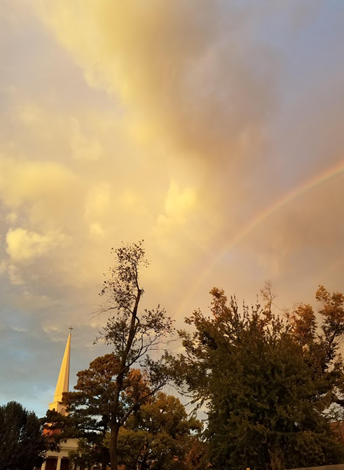
(Photo credit: R. A. Stites, First United Methodist Church, Fayetteville, AR, 2022)
[1] Many other Psalms contain the same message: Psalm 27:1; 34:4-8; 46:1-3; 56:3-4; 91:4-5; 107:28-30; 112:6-8.
[2] From “That’s Who I Praise” by Brandon Lake. Here’s a link to the song if you would like to listen.
[3] Article from Slate.com: At last we know why the Columbine killers did it.