Prayer: Living in a Danger Zone
Ruth Ann Stites, Staff Writer
Amazon likes to tempt customers with special deals throughout the year. While offering tempting deals on things we didn’t know we needed, it also offers unexpected discounts on things we are actually thinking of buying. Last summer there was a book I had on my purchase list on sale, a collection of C. S. Lewis’ writings on prayer entitled How to Pray: Reflections & Essays. I purchased a few for gifts and one for myself. After sitting in a box for a few months, I finally started digging into this thought-provoking collection on prayer.
Lewis believed in the necessity of free will to allow the created to choose to love the Creator fully…or not. He saw the human ability to choose as giving “us small creatures the dignity of being able to contribute to the course of events…” both in our actions (work) and our requests to God to modify events beyond our control (prayer).[1] He posits a world designed by God with “a certain amount of free play [that] can be modified in response to our prayers.” But he notes, “God has left Himself a discretionary power.” It is He who chooses to grant or deny our prayers. Otherwise, “prayer would be an activity too dangerous for man….”
Think about the power of prayer unfettered by God’s discretionary power. If prayer, as Lewis says, is “unlimited by space and time,” then what events, past, present, and future, would remain stable enough to “be” in any meaningful sense of that word? The world would be formed and reformed to our whims. Who would die because the one who prayed had a grudge or live because of a longing for more time with a loved one? Given the realities of human nature, the power of unfettered prayer is too bleak to contemplate for more than a moment in time (Rom. 3:10-18). But God had no intention of giving humans that kind of power. He allows us to participate in creation for both good and ill but not to place it in jeopardy of the destruction of its very fabric.
I liked the final illustration Lewis used, “It is not unreasonable for a headmaster to say, ‘Such and such things you may do according to the fixed rules of this school. But such and such other things are too dangerous to be left to general rules. If you want to do them you must come and make a request and talk over the whole matter with me in my study. And then—we’ll see.’”
Think of the freedom that gives us! It means we can ask anything we want in prayer and know there is Someone who knows so much more than we do who will determine if it is granted. Furthermore, He is going to use even our most selfish and destructive prayers to teach us, so we grow in His likeness through prayer. It means we can pour our whole heart out to God without fear that He will act in any way other than in accordance with His divine nature. You’ve heard the old adage: God answers prayer with a yes, a no, or a maybe. But rather than an aAdministrator rubberstamping a request, how much more personal is the view of prayer as a request to the HHeadmaster who not only grants or denies the petition, but talks over the whole matter with you in His study?
Reflection Questions:
- Have you ever thought of prayer as dangerous? Why or why not?
- How do you “see” God when He answers our prayers? Is He a patient Father taking you on His knee to hear your concerns, a beneficent Ruler who hears and decides how to handle your requests before moving on to the next petitioner, or some other image? Do you like the Divine Schoolmaster Lewis envisions in his essay as an image of how God hears your prayers?
- If, as so many of the Psalms illustrate, you don’t have to always pray “nice” prayers (think of all the times David asks God to smite his enemies), how much more honest with God can you be? Knowing He allows you to bring anything, even things He will not give you, to Him, are you more comfortable being so transparent with God in your prayer life?
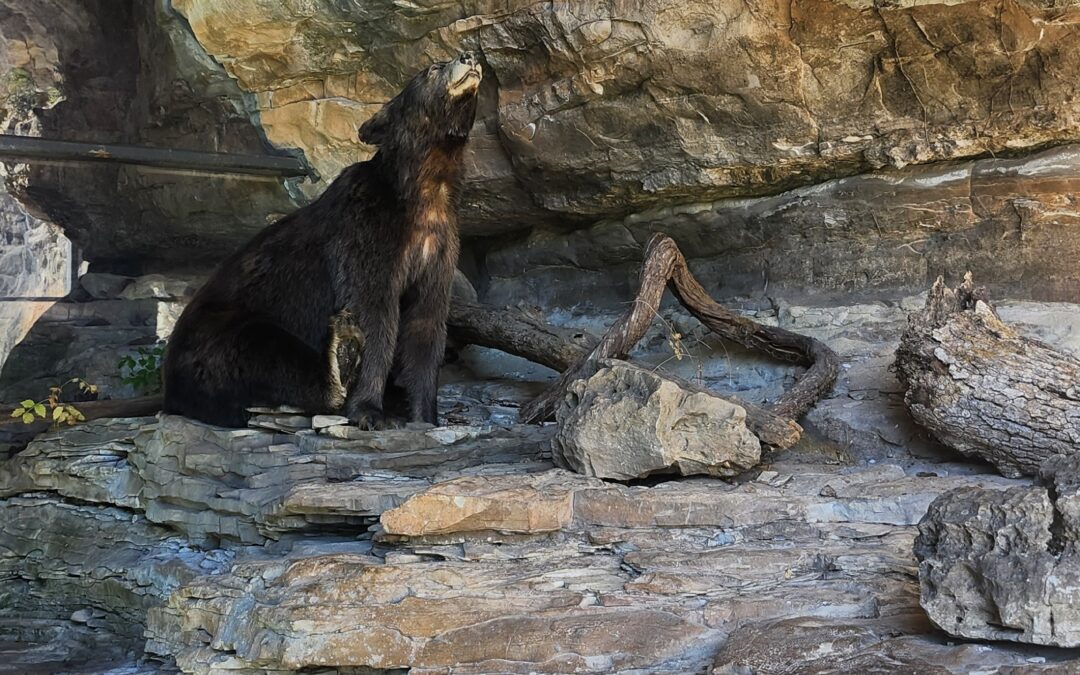
(Photo description and credit: On a fine fall day my sister and I went for a walk at Dogwood Canyon Park in Stone County Missouri near the town of Lampe. I took a picture of a mountain lion and bear displayed in the entry to the visitor’s center. As I was looking through my photos for this post, I thought it illustrated the dangers of the natural world as a comment on the dangers of the spiritual one prayer works in. R. A. Stites, Dogwood Canyon Park, Visitor’s Center diorama, 2024.)
[1] Quotes from pages 20-22 of How to Pray.