We Are the Sheep of His Pasture
Ruth Ann Stites, Staff Writer
The Tigris and Euphrates rivers originate in the rugged mountains of modern-day Turkey. They flow south and east toward the Persian Gulf. In the flatter zones of the countries we call Syria and Iraq today the rivers slow. They deposit the rich sediment that makes their course to the sea a wide, fertile plain. And here, in a “cradle of civilization” a part of the “Fertile Crescent,” agriculture established itself as a way of life. Some 10,000 or more years ago the nascent farmers decided it would be convenient to bring animals to them rather than hunt them in the wild reaches of the surrounding mountains. One of the creatures they brought home was the Asiatic wild mouflon (Orvis gmelina), the primary ancestor of the more than 1,000 breeds of domestic sheep today.[1]
These early domesticated sheep didn’t look like the fluffy creatures we picture when we think of sheep.[2] The Asiatic wild mouflon sports large, curving horns (males and some females are horned) and “…have a short-haired, reddish-brown coat with a bristly outer layer that does not shed.”[3] But, from the beginning of domestication, sheep were kept and managed to provide important resources for the community.
From earliest times, sheep were a major source of meat, pelts, leather, lanolin and milk. Early domesticated sheep had hairy coats that needed to shed. Today’s Soay breed resembles these early domestic sheep. Selective breeding specifically for wool began around 6000 BCE. Early woven wool textiles date to between 4000 and 3000 BCE.[4]
Sheep are first mentioned in the Bible in Genesis 4:2 where Abel is described as tending sheep while his brother, Cain, was a gardener. In the New International Version of the Bible the word “sheep” is found over 200 times and, with related words like “ram” and “lamb” references to sheep exceeds 550 times. The last mention of sheep/lamb is Revelation 22:3. Thus, from beginning to end, sheep have a place in biblical literature. Obviously, in both a literal and symbolic way, sheep are important in Scripture. They were a measure of wealth, provided essential resources (meat and milk for food, wool for cloth, and skins for parchment), were the most important sacrificial animal for the Israelites, and gave us wonderful metaphors for the human condition and its resolution.
Psalm 100:3 says, “Know that the Lord is God. It is he who made us, and we are his; we are his people, the sheep of his pasture.” Since the Psalm calls us His people and His sheep, we should “unpack” the metaphor of sheep in more depth.
Let’s consider how people are like sheep. People, like sheep, are useful. From the very beginning God gave humankind a useful job. Adam’s job description was to take care of and protect the garden (Gen. 2:15). Even after Adam and Eve were barred from Eden, their mandated role didn’t change. If anything, it got bigger and more robust for God’s people beginning with Abraham whom God promised to make into a great nation (Gen. 12:2-3). He tells Moses when He spoke to him on the mountain, “‘You yourselves have seen what I did to Egypt, and how I carried you on eagles’ wings and brought you to myself. Now if you obey me fully and keep my covenant, then out of all nations you will be my treasured possession. Although the whole earth is mine, you will be for me a kingdom of priests and a holy nation.’ These are the words you are to speak to the Israelites” (Exod. 19:4-6). In the New Testament Peter includes all believers in Christ, not just Jewish believers, “But you are a chosen people, a royal priesthood, a holy nation, God’s special possession, that you may declare the praises of him who called you out of darkness into his wonderful light” (I Peter 2:9).
There are lots of similarities between the nature of sheep and people. Sheep are intelligent creatures with excellent memories. They are curious, and that curiosity often leads them into trouble. They often fail to learn from their mistakes and take the same foolish action repeatedly. Sheep can be emotional even to the point of giving up on life and dying from curable illness or injury. They are herd animals; they live in a community, the flock. They have social bonds within the flock, have a complex hierarchy within it, and grieve when they lose a companion.[5]
Sandy Swartzentruber notes that, while sheep were important in Bible times, “…they weren’t good at taking care of themselves. They needed a shepherd to keep them healthy and safe. Maybe that’s why the Bible compares US to sheep so often. We’re not always good at taking care of ourselves either. We need Jesus, our Good Shepherd, to guide us.”[6] And that is an excellent meeting place for Psalm 100’s statement that Israel was “ the sheep of his pasture,” the inclusion of all Christ followers as part of “his people” (Rom. 11:11-31), and prayer.
When you pray you come as one of HIS sheep and all that implies. (And I have only touched on some of the most obvious likenesses between us and sheep in this Reflection.) We come with joy because He made us, we come with gladness because we belong to Him, we come with thanksgiving because He provides and protects us. We come with praise because He has promised to love us faithfully forever. As the greatest of the “sheep” Psalms concludes, “Surely your goodness and love will follow me all the days of my life, and I will dwell in the house of the Lord forever” (Ps. 23:6).
Reflection Questions:
1. Were you aware of how important sheep were to people in Bible times? Did learning more about them increase your understanding of either or both their practical uses and their symbolic ones? How?
2. What other likenesses between sheep and people can you think of? How do likenesses between people and sheep affect your relationship with the Good Shephard, Jesus?
3. Look at Psalm 23. What benefits do the sheep find in following their shepherd? How can you use those benefits to deepen your prayer life? Are you glad you are a sheep of His pasture? Why is that true (or not)?
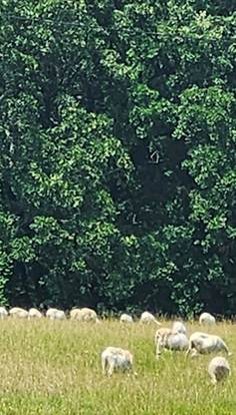
(Photo description and credit: A flock of sheep grazing peacefully in their pasture is a reminder of how, like this flock’s shepherd, the Lord cares for His sheep. Credit: R. A. Stites, near Pea Ridge, AR, June 2025.)
[1] Sheep and goats are related. Both belong to the taxonomic Family Bovidae, Subfamily Caprinae but belong to different genus’s, sheep (Ovis) and goat (Caora).
[2] Sheep | Characteristics, Breeds, & Facts | Britannica
[3] Heritage Sheep in American History – The Livestock Conservancy
[4] Ibid.
[5] If you would like more information about the mental and social intelligence of sheep look at: 5 Amazing Facts About Sheep – Lighthouse Farm Sanctuary, 15 Ama zing Sheep Facts | World Animal Protection, The Surprising Intelligence of Sheep (Ft. @Mickey Pardo, PhD)