Sing Praises to the Lord
Ruth Ann Stites, Staff Writer
“Music is what feelings sound like.”[1] This evocative quote expresses how deeply music affects human beings. Not only is it expressive of our feelings, it is closely tied to our memories. Dementia patients often find music therapeutic. It stimulates memory far into the throes of their disease progression. An ability to relate to music is said to be the last sense to go in this dire decline into nothingness. But that is just the tip of the therapeutic iceberg as an August 5, 2026, online article on the National Geographic website discusses, “Songs may help reduce pain—and even treat stroke symptoms.”
Scientists are identifying how different elements of sound affect the brain and body—and how clinicians could use this knowledge to develop personalized therapies. One of the clearest examples of that work is in stroke rehabilitation.[2]
Even before birth a baby typically is exposed to music, and that musical environment only expands after the child is born. Our brains process speech and singing differently; while using many of the same areas as speech, singing requires other regions of the brain as well including right brain activity unneeded in speaking. Even more fundamentally, our very genes determine not just our musical abilities but how we respond to music. In 2025 the Max Planck Institute for Psycholinguistics in the Netherlands reported the results from a study of 9,000 twins concluding:
The study found that genetic factors affecting music enjoyment are distinct from those linked to general reward sensitivity or musical perception. While some genes related to general pleasure responses influence music enjoyment, others specifically shape how people emotionally engage with music, move to rhythm, or participate in musical activities.[3]
The interplay between experiencing the “music of our lives” and how we find pleasure in music through the intricacies of brain structure and genetic propensity is a complex web that is only partially understood.
Because music seems to be universally significant to people, it is little wonder that it is integral to worship as well. The unifying event in the history of Israel turning a people into a nation was the Exodus. In Exodus, after crossing the Red Sea, Moses leads the people in a song of praise to the God who had rescued them from Egypt and its army. Then his sister, the prophetess Miriam, led the women as they sang, played the timbrels, and danced praising their Lord who had rescued them (Exod. 14-15). While singing was clearly a part of worship—the Lord gave Moses a song to teach the Israelites as a testimony in Deuteronomy 31:19-22—it wasn’t until the time of David that musical instruments were regularly incorporated into Jewish ritual (I Chron. 15:1-22).
Dr. Paul Chappell, president of West Coast Baptist College and pastor of Lancaster Baptist Church, offers seven purposes for the inclusion of music in Christian worship. In the New Testament, Colossians 3:16 centers our focus on Christ in our worship to fulfill the purpose of Edification. The other six have their roots in the Old Testament expressing the purposes music served then as well as now: Worship (II Chron. 29:28); Thanks (Psalm 147:7); Rejoicing (Psalm 98:4-5); Consecration (Psalm 139:23; 111:1); Evangelism (Psalm 40:3); and Preservation of Faith (Psalm 145:4-5).[4]
Sometimes we tend to limit our prayer lives to a formula that, while meaningful and valuable, lacks spontaneity. Since we have approached the Psalms in this year’s Reflections in ways that deepen and challenge our view of prayer, and knowing worship is a part of any prayer life worth having, what if we added song to our prayers? After all, the word “Psalms” is the English translation of the Greek word “psalmoi” the plural of “psalmos” meaning a song or the playing of a musical instrument. In Hebrew it is “Tehilim” meaning “Praises” or “Songs of Praise.”[5]
Psalm 100, our Psalm of the month, was translated into English meter by William Kethe in 1561 appearing in the Anglo-Genevan Psalter as “All People That on Earth Do Dwell.”[6] The words were paired with a melody credited to Louis Bourgeois and has been sung both by its title and its affectionate nickname, the “Old Hundredth,” since the 16th century.[7] This is hardly the only English rendition of Psalm 100. Contemporary Christian musician Chris Tomlin’s recording from 2014 (from his Love Ran Red album) of “Psalm 100” has become a much-loved call to worship since its release.[8]
So, how can you incorporate this short but powerful Psalm into your prayers through song? First, in your private prayers, you might try singing an arrangement you like as your personal call to worship and thanksgiving. Remember, this is not about performance. It makes no difference if you are a good singer or the least able singer you know. If you feel the need for accompaniment, choose a “sing along” option from the many available on YouTube and elsewhere. (Sometimes we need to take “baby steps” as we undertake a new practice. If you just can’t sing a Psalm, try reading it aloud without music.) Let yourself be creative and alternate song and petition. The object is to worship as fully as possible and music, that powerful force of memory and emotion in our lives, can be part of expressing our deepest longings and greatest thanksgiving and praise.
As Michael Floyd pointed out in his introduction to our August posts, Psalm 100 was intended for the congregation, not just the individual. Another musical opportunity offers itself if, when it’s your turn to lead a group prayer, you incorporate the “Old Hundredth” into it. Again, you may just want to read it (or recite) but let it be an opportunity to raise your voice in prayerful song (Acts 16:25; I Cor. 14:15; Rev. 7:9-10).
Reflection Questions:
1. How has music impacted your life? For you, what is some of the most moving music? What memories come with hearing it?
2. Dr. Chapell’s seven purposes is a good starting place for understanding the role of music in worship. Another interesting article you might find insightful is The Three R’s: Why Christians Sing. What other purposes (or roles) did music play in the Old and New Testaments? What other purposes does music play in the church today?
3. Are you ready to try incorporating song into your prayers? While we focused on Psalm 100 in this post, there are many songs of worship and praise you could use in this exercise both from the Psalms and from our rich church traditions. What are you going to do? How did your singing experience turn out?
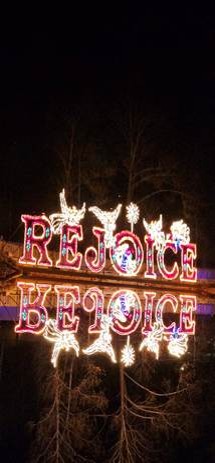
(Photo description and credit: While this photo is of a Christmas display, it imparts the central focus of Psalm 100, “Worship the Lord with gladness.” Credit: R.A. Stites, Silver Dollar City, MO, December 2024.)
[1] The Power of Music for Aging Adults with Dementia. Another interesting article is Music and dementia – PMC from the National Library of Medicine.
[2] Summary from National Geographic’s Facebook page. Another interesting website is Explore How Music Can Promote Your Brain Health a project of AARP and the Global Council on Brain Health.
[3] Genetic Study Finds Music Enjoyment May Be Hardwired
[4] 7 Biblical Purposes for Music | Paul Chappell
[6] The Anglo-Genevan Psalter was published in Geneva, Switzerland. “All People That on Earth Do Dwell” appeared in Day’s Psalter the following year, 1562, in London, England.
[7] If you do not know “All People That on Earth Do Dwell,” you probably do know the tune as the “Doxology.”
[8] If you would like to explore some of the settings for Psalm 100, use your favorite search engine to find “Psalm 100 set to music.” My search was on Google. I found a performance by Troy Mitchell in Hebrew set to the tune of “Simple Gifts.” I enjoyed it even though I couldn’t understand it. (I could only find it on Facebook which requires an account to access the song.)