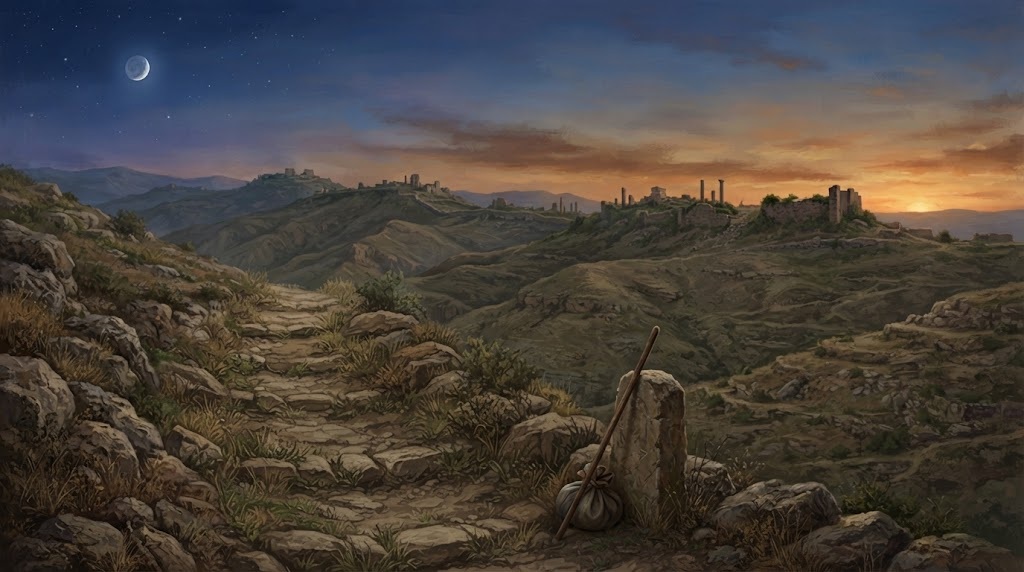
God Our Keeper (Psalm 121)
Michael Floyd, Editor
A song of ascents.

I lift up my eyes to the mountains—
where does my help come from?
My help comes from the Lord,
the Maker of heaven and earth.
He will not let your foot slip—
he who watches over you will not slumber;
indeed, he who watches over Israel
will neither slumber nor sleep.
The Lord watches over you—
the Lord is your shade at your right hand;
the sun will not harm you by day,
nor the moon by night.
The Lord will keep you from all harm—
he will watch over your life;
the Lord will watch over your coming and going
both now and forevermore. — Psalm 121
Psalm 121 opens with a question, and it’s not as innocent as it sounds. “I lift up my eyes to the mountains–where does my help come from?” (v. 1). The hills were never neutral ground. Moab worshiped Chemosh on them, Ammon worshiped Molek, Phoenicia worshiped Baal and Asherah–and more than once, Israel’s own kings imported those very shrines rather than tearing them down. Solomon built high places for Chemosh and Molek right outside Jerusalem (1 Kings 11:7). Ahab, married into Phoenician royalty, set up an altar for Baal in Samaria instead (1 Kings 16:31-33). So the question in verse 1 isn’t scenic. It’s asking which hill, which god, actually delivers. Verse 2 answers before the question even finishes: “My help comes from the Lord, the Maker of heaven and earth” (v. 2)–the Maker, not the hills themselves.
The Hebrew word behind “watches” and “keeps” is shamar–the term that simply means to guard closely–and it shows up five times in these eight verses (vv. 3, 4, 5, 7, 8)–repetition that carries the whole argument of the psalm. This is the same word used for Adam’s job tending the garden back in Genesis 2:15, which tells you something about the kind of attention we’re talking about: hands-on and ongoing, not a once-a-year inspection. Verse 4 spells it out: “He who watches over Israel will neither slumber nor sleep.” Could Israel’s God ever be caught napping on the job? No–that’s the exact taunt Elijah threw at Baal’s prophets on Mount Carmel (1 Kings 18:27). This psalm makes sure that charge can never stick to the Lord.
Verses 5 and 6 get specific: “the sun will not harm you by day, nor the moon by night.” Sunstroke was a real danger for travelers in that climate, and moonlight carried its own folklore of hazards across the ancient Near East. People who prayed this psalm still got sunburned. They still ran into real trouble on the road. Translation? The promise was never that nothing bad would happen. It’s that nothing happens outside the attention of the One you’re bringing it to.
Verse 8 pulls all of this into the most ordinary language in the whole psalm: “the Lord will watch over your coming and going both now and forevermore.” Coming and going–the commute, the errand run, the walk to the mailbox, the flight home. This was written for pilgrims headed to Jerusalem, sure, but it covers the whole of an ordinary life’s movement, not just the one big trip. Did you catch that? Not a single request shows up anywhere in this psalm. Every line from verse 2 on states a fact about God rather than asking Him to act–which means the “prayer” here is really just rehearsing out loud what’s already true.
Jesus takes this psalm’s language and applies it to Himself without blinking: “I give them eternal life, and they shall never perish; no one will snatch them out of my hand” (John 10:28). Psalm 121 credits that sleepless watching to the Father; Jesus claims it for Himself. If anything, that watching sharpens once we belong to Him, because now He intercedes. The night before His death, He prayed exactly the kind of keeping this psalm describes, over His own disciples: “Holy Father, protect them by the power of your name… While I was with them, I protected them and kept them safe” (John 17:11-12). Hebrews says He “always lives to intercede” for those who come to God through Him (Heb. 7:25). Not only did Jesus claim this psalm’s watching for Himself–He’s still doing it, on your behalf, right now.
If your prayers tend to sound like persuasion–trying to talk a distracted God into finally paying attention–Psalm 121 offers a different posture. You’re not waking Him up; you’re simply acknowledging the One who was already watching before you ever thought to ask–which is really all prayer is doing here: reminding yourself out loud of what was already true. So the next time anxiety has you lying awake running through worst-case scenarios, remember the plain answer sitting right there in verse 4: He who keeps you will not slumber. Someone has to stay awake–and it was never going to be you.
Questions for Reflection:
- The psalm asks where help actually comes from, then answers before any doubt can creep in: “the Maker of heaven and earth” (v. 2). What are the modern equivalents of those hillside shrines–the things you instinctively look to for security before you think to look to God? What would it take to notice that reflex in the moment it happens?
- The word “watches” appears five times in eight verses, describing continuous attention rather than an occasional rescue. Does your picture of God’s care feel more like a God who steps in occasionally when things get bad, or one who never actually stopped paying attention? What shaped that picture?
- Verse 8 covers the most unremarkable parts of life: “your coming and going.” Where in your ordinary routine–commuting, errands, the parts of the day nobody would call a crisis–have you never thought to invite God’s attention, simply because nothing seemed dramatic enough to warrant it?
- Jesus prayed this same kind of keeping over His disciples the night before He died (John 17:11-12), and Hebrews says He still intercedes for us now. Does it change anything to think of your current worries as already being prayed over by someone else, right now, whether or not you remember to ask?
(Image description and credit: Dusk settles over the Judean hill country as sun and moon share the sky above a pilgrim’s path, evoking God’s unbroken watch. Image created with Google Gemini.)