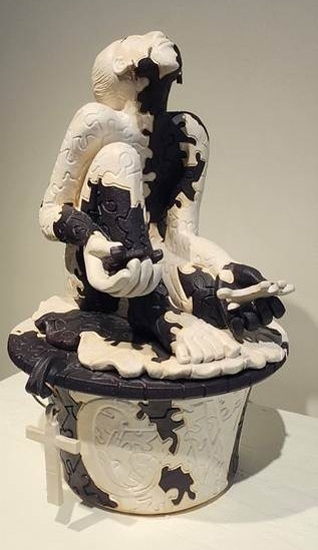
Putting the Pieces of Intercession Together
Ruth Ann Stites, Staff Writer
What happens when former Marine turned minister, the newly Reverend Samuel (Sam) Whitehead, moves his family (wife, kids, mother-in-law, brother-in-law, and the family dog) to Wood Falls, Kansas, to take up his first ever assignment as pastor? Well, in the 1969 movie, Angel in My Pocket, starring Andy Griffith, Lee Mariweather, and Jerry Van Dyke, a great deal of mayhem, a lot of “what would Jesus do” living, and plenty of laughter as the new Pastor Sam (Griffith) tries to negotiate a 60 year old feud between two of the town’s founding families, ghosts in the cemetery frightening his children, more town gossips than he can count, and a brother-in-law (Van Dyke) who is making moonshine in the church basement.[1]
Angel in My Pocket addresses problems in an entertaining way that is classic Americana with a more realistic view of small-town life than any of Griffith’s “Mayberry” work. Churches have problems, and the solutions are often messy and costly to the people involved. In his letters to the Corinthian church, Paul is in much the same position as Reverend Sam, trying to help a church deal with internal strife and external temptations. In II Corinthians 13:7-9 he describes the prayers he and others offer for the people in this beleaguered church, “Now we pray to God that you will not do anything wrong—not so that people will see that we have stood the test but so that you will do what is right even though we may seem to have failed. For we cannot do anything against the truth, but only for the truth. We are glad whenever we are weak but you are strong; and our prayer is that you may be fully restored.” Paul intercedes in prayer for his fellow believers even as he offers them correction and guidance.
The word “intercession” is defined as “the act of interceding” or “prayer, petition, or entreaty in favor of another.”[2] It is involving oneself in pleading another person’s case such as praying for a child to accept Christ, a sick friend, a broken marriage in our church, a community crisis, or fellow believers suffering persecution on the other side of the world. We place ourselves as a “go between” to ask for something needed in other’s lives. Paul in II Corinthians 5 uses a different word, reconciliation, to take us to the heart of intercession. “All this is from God, who reconciled us to himself through Christ and gave us the ministry of reconciliation: that God was reconciling the world to himself in Christ, not counting people’s sins against them. And he has committed to us the message of reconciliation. We are therefore Christ’s ambassadors, as though God were making his appeal through us. We implore you on Christ’s behalf: Be reconciled to God” (II Cor. 5:18-20). All believers are sinners saved by grace who need to bring everything to God in prayer, to deal with the creeping rot of this world that draws us away from Him, to be reconciled to the new life He has given us. All unbelievers are sinners who have not yet been saved by grace and need to be reconciled to Him in Christ. Reconciliation is about restoration of relationships, agreement, solution, acceptance of reality.[3] Such is the work of intercessory prayer.
Usually praying for ourselves is not called intercession but, using Paul’s amazing truth about our place as ambassadors for Christ reaching out to the world with our message of reconciliation, we might consider them as such. . We communicate with God about restoration of relationships, solutions to problems, and acceptance of what is most real, God Himself. Only then can we intercede for and with others for the same restoration based on our new life in Christ, “So from now on we regard no one from a worldly point of view. Though we once regarded Christ in this way, we do so no longer.Therefore, if anyone is in Christ, the new creation has come: The old has gone, the new is here!” (II Cor. 5:16-17).
Psalm 86 is considered by many authors as a model of how intercessory prayer should be done as it blends personal need, deep worship, petition, and confidence in God’s character. From the perspective of carrying out the ministry of reconciliation, let us look at this Psalm. It was written by David, and seven of its fifteen verses can be classified as intercession by him for himself. He asks for help to solve problems (solutions), acknowledges his dependance on God (reality), and asks for protection against enemies (relationships). Only in verse 5, a transition verse from his opening intercession to a focus on praise, does he include others as intercessors, “You, Lord, are forgiving and good, abounding in love to all who call to you.”[4]
From another perspective, David intercedes for himself because he is more than a person seeking help from his Lord. This is a king, who must rule a nation well, seeking help from God to be and do what is pleasing in His sight as a leader. In that sense, interceding for himself is also interceding for Israel. He knows who he wishes to please as a man and as a king, and he seeks the One who is reconciling His man, His people, and their government to Himself as David’s prayer so richly indicates.[5]
How does this view of Psalm 86 apply to our prayer lives? When we pray about the condition of our hearts, we may call it intercession for ourselves or repentance, confession, and lament. But, regardless of the labels we apply, we are asking God to restore our relationship with Him or with others. We are presenting Him with issues we cannot handle on our own. We have had to come to the end of ourselves before we can find the different kinds of reconciliation our hearts desire. When we lift others to God through prayer (the usual definition of intercession) we are acting as ambassadors (authorized representatives or messengers) between God and humanity in Christ’s name seeking restoration and reconciliation as needed for living in a broken world. And, as this Psalm also wonderfully describes, this results in adoration and praise of the One who is worthy and able to answer, because as Paul put it in his prayer for the Ephesians, “Now to him who is able to do immeasurably more than all we ask or imagine, according to his power that is at work within us, to him be glory in the church and in Christ Jesus throughout all generations, for ever and ever! Amen” (Eph. 3:20-21).
Reflection Questions:
1. How have you approached difficulties in churches you have been or are now part of? Does applying these thoughts about our ministry of reconciliation from II Corinthians 5 help you formulate new approaches to church conflicts?
2. Have you thought about how deeply praise and adoration of God should be woven into intercession for others? Why do you think this is so important? Have you ever considered intercession as an act of worship?
3. As a model for intercessory prayer, how can you make your intercession more meaningful by incorporating the elements we find in this Psalm when you seek favor for others in your prayers?
(Photo description and credit: Sculptor and ceramist Troy Jackson is included in the 100 or so Cherokee citizens who have the distinction of being awarded the title of National Treasure for their efforts to keep their tribal traditions alive. His work speaks “of his faith as a Christian throughout both his European and Cherokee heritage.” His human figure pieces “are often shown as in reverence to prayer with faces and hands turned upward.” This piece, entitled “Putting The Pieces Together” captures the intensity of Psalm 86 as David tries to fit the pieces of intercession together for himself. Credit: Photo by R. A. Stites taken in June 2026 at an exhibit of Troy Jackson’s work at the Gallery at Historic Cane Hill, Cane Hill, Arkansas. Quotes from the exhibit’s interpretive labels.)
[1] Sources and reviews: Angel in My Pocket – Wikipedia, Movie Review: Andy Griffith in “Angel in My Pocket”, Angel in My Pocket | Rotten Tomatoes.
[2] INTERCESSION Definition & Meaning – Merriam-Webster
[3] RECONCILE Definition & Meaning – Merriam-Webster
[4] Emphasis added.
[5] We, too, even if our spheres of influence are much smaller than those of a king of a nation, have people who depend on us as leaders, role models, and mentors. This should provide yet another reason for our honest intercession for our own brokenness as we seek to be God’s person to those around us.