Persistent Prayer (Psalm 86)
Michael Floyd, Editor
Hear me, Lord, and answer me,
for I am poor and needy.
Guard my life, for I am faithful to you;
save your servant who trusts in you.
You are my God;
have mercy on me, Lord,
for I call to you all day long.
Bring joy to your servant, Lord,
for I put my trust in you.
You, Lord, are forgiving and good,
abounding in love to all who call to you.
Hear my prayer, Lord;
listen to my cry for mercy.
When I am in distress, I call to you,
because you answer me.
Among the gods there is none like you, Lord;
no deeds can compare with yours.
All the nations you have made
will come and worship before you, Lord;
they will bring glory to your name.
For you are great and do marvelous deeds;
you alone are God.
Teach me your way, Lord,
that I may rely on your faithfulness;
give me an undivided heart,
that I may fear your name.
I will praise you, Lord my God, with all my heart;
I will glorify your name forever.
For great is your love toward me;
you have delivered me from the depths,
from the realm of the dead.
Arrogant foes are attacking me, O God;
ruthless people are trying to kill me—
they have no regard for you.
But you, Lord, are a compassionate and gracious God,
slow to anger, abounding in love and faithfulness.
Turn to me and have mercy on me;
show your strength in behalf of your servant;
save me, because I serve you
just as my mother did.
Give me a sign of your goodness,
that my enemies may see it and be put to shame,
for you, Lord, have helped me and comforted me.
— Psalm 86:1-17
Most of us have experienced the slow erosion of a prayer life. We bring the same need to God again and again, nothing visibly changes, and eventually we stop asking. Psalm 86 is the only psalm attributed to David in the third book of the Psalter, and it stands out for one reason: David asks—repeatedly, urgently, and without apology. And yet it isn’t desperate grasping, but simple confidence grounded in something solid. “You, Lord, are forgiving and good, abounding in love to all who call to you” (v. 5). David knows who he’s talking to. That changes everything about how he prays.
Notice how many requests David makes in seventeen verses. He asks to be heard (v. 1), to be saved (v. 2), to receive mercy (v. 3), to be given joy (v. 4). He calls out in distress (v. 7), asks to be taught (v. 11), given an undivided heart (v. 11), shown a sign of goodness (v. 17). He comes to God “all day long” (v. 3). This is persistent prayer in practice—not one polished petition followed by respectful silence, but an ongoing, returning, specific conversation. David never apologizes for coming back. He doesn’t say “I know I’ve already asked this, but…” He simply returns. Psalm 86 gives us both permission and a model to do the same.
At the center of David’s many requests stands one that eclipses the rest: “Give me an undivided heart, that I may fear your name” (v. 11). His enemies are real and dangerous (v. 14), and he asks for deliverance from them. The deepest petition, however, isn’t about circumstances; rather, it’s about the condition of his heart. The Hebrew word yachad means unified, whole—that is, completely oriented in one direction. David knows his own tendency to want God and also to want what God offers instead of God—to pray and yet trust his own resources, to seek the Lord’s face while watching the exits. Persistent prayer is what forms an undivided heart: in returning to God again and again, we slowly discover what we actually want most.
What makes David’s persistence sustainable is not willpower—it’s his clarity about who God is. Verse 15 is the load-bearing wall of the psalm: “But you, Lord, are a compassionate and gracious God, slow to anger, abounding in love and faithfulness.” These words echo God’s own self-disclosure at Sinai (Exodus 34:6)—the most foundational description of divine character in Scripture. David isn’t improvising—he’s anchoring his prayer in what God has already revealed about Himself. This is what distinguishes persistent prayer from spiritual pressure tactics. We don’t persist to wear God down or change His mind. We persist because the One we’re speaking to is, by nature, compassionate and gracious—abounding in love toward all who call.
Jesus is the fulfillment of everything Psalm 86 reaches toward. He is the only human being who ever prayed with a truly undivided heart—whose whole being was oriented toward the Father without reservation or competing desire. In Gethsemane, under the full weight of what was coming, He still prayed, “Not my will, but yours be done” (Luke 22:42). That is an undivided heart at its most costly. Jesus doesn’t just model persistent prayer—He practices it on our behalf right now. The writer of Hebrews says He “always lives to intercede” for us (Hebrews 7:25). Our prayers are joined to His unceasing intercession before the Father. And through His Spirit, He forms what we cannot manufacture—the undivided heart David prays for. When our prayers are fragmented and our persistence flags, the Spirit who “intercedes for us with groanings too deep for words” (Romans 8:26) is already at work in us.
Persistent prayer is not a technique for getting God to act—it’s the shape a living relationship with God takes over time. We return because He is good. We ask again because He is gracious. We seek an undivided heart because He is worth wanting completely. If your prayer life has contracted to rare moments of crisis, or gone quiet altogether, treat Psalm 86 as an invitation: bring what you have, ask specifically, come back tomorrow.
Questions for Reflection:
- David prays “all day long” (v. 3)—throughout his waking hours, not just at set devotional times. What does your own pattern of prayer look like across the day? What tends to crowd out the returning, the checking in, the small requests that mark ongoing conversation with God?
- The single request that goes deepest in this psalm is for an undivided heart (v. 11). What divides your heart most in this season? What are the competing loyalties or desires that keep you from wanting God with your whole self—and have you ever actually brought that division to Him in prayer?
- David grounds his persistence not in his own worthiness but in God’s character (v. 15): “You, Lord, are a compassionate and gracious God.” When prayer feels futile or your faith runs thin, what do you actually believe about who you’re speaking to? How does your working picture of God shape whether you keep asking?
- Hebrews 7:25 tells us that Jesus “always lives to intercede” for us—that He is praying for you right now. What difference does it make to know that your prayers are joined to the ongoing intercession of Christ, that you are never praying alone? Does this feel like something you actually believe, or a theological fact that hasn’t yet changed how you pray?
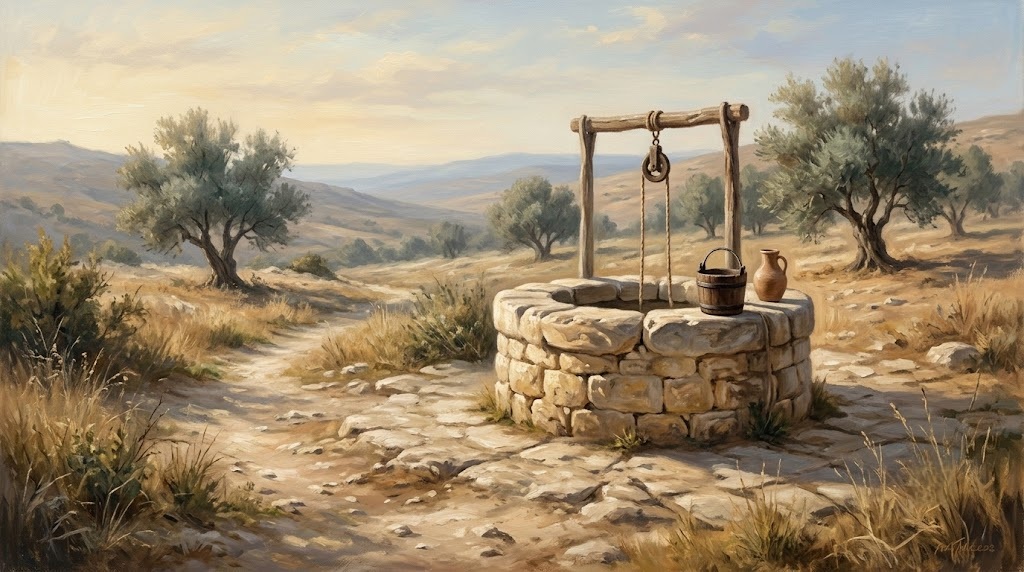
(Image description and credit: An ancient stone well worn smooth by countless returning hands, resting in early morning light—a quiet image of prayer as faithful, lifelong returning to God. Image created with Google Gemini.)