Waiting in Silence (Psalm 62)
Michael Floyd, Editor
For the director of music. For Jeduthun. A psalm of David.

      Truly my soul finds rest in God;
         my salvation comes from him.
      Truly he is my rock and my salvation;
         he is my fortress, I will never be shaken.

      How long will you assault me?
         Would all of you throw me down—
         this leaning wall, this tottering fence?
      Surely they intend to topple me
         from my lofty place;
         they take delight in lies.
         With their mouths they bless,
         but in their hearts they curse.

      Yes, my soul, find rest in God;
         my hope comes from him.
      Truly he is my rock and my salvation;
         he is my fortress, I will not be shaken.
      My salvation and my honor depend on God;
         he is my mighty rock, my refuge.
      Trust in him at all times, you people;
         pour out your hearts to him,
         for God is our refuge.

      Surely the lowborn are but a breath,
         the highborn are but a lie.
         If weighed on a balance, they are nothing;
         together they are only a breath.
      Do not trust in extortion
         or put vain hope in stolen goods;
         though your riches increase,
         do not set your heart on them.

      One thing God has spoken,
         two things I have heard:
         “Power belongs to you, God,
         and with you, Lord, is unfailing love”;
         and, “You reward everyone
         according to what they have done.” -- Psalm 62
Many of us treat silence as what happens when prayer runs out of words. Psalm 62 treats it differently. “Truly my soul finds rest in God” isn’t a description of a quiet moment; it’s a theological claim about where the soul belongs. David wrote this under real threat—people actively working against him, lying to his face, plotting to bring him down. His opening line isn’t a cry for help. It’s a declaration of position.
Rock and Rest
The Hebrew word behind “finds rest” carries the sense of settled stillness. David uses it for his soul, not his circumstances. His circumstances, as verses 3 and 4 make clear, were anything but still.
He doesn’t dispute the danger. What he disputes is where that danger places him. God is his rock, his salvation, his fortress—and these aren’t words meant merely to comfort. They’re load-bearing. A rock doesn’t shift under weight. A fortress doesn’t fall to insults and lies. David’s calm in the psalm isn’t manufactured; it’s structural. He has placed himself on something that doesn’t move when pressure is applied.
Command, Not Feeling
Verse 5 catches you if you’re reading carefully: “Yes, my soul, find rest in God.” After the declaration of verse 1 — “my soul finds rest” — David turns around and commands himself. He’s preaching to his own interior.
This is one of the most honest moments in the Psalter. The soul that declared rest in verse 1 apparently needs to hear it again in verse 5 — needs, in fact, to be told. Rest in God isn’t a permanent emotional state that, once achieved, simply continues. It’s a posture the soul must keep choosing, especially when enemies are circling and confidence is wearing thin.
The refrain is nearly identical in both verses, but the mood shifts from indicative to imperative. David knows where rest is found. The work is getting his soul to stay there.
Pour Out and Let Go
Verse 8 opens outward: “Trust in him at all times, you people; pour out your hearts to him, for God is our refuge.”
“Pour out your hearts to him” is the psalm’s key to what silence before God actually involves. It’s directional: bring everything to God rather than anywhere else. Whatever you’re carrying — whether anxieties, grievances, fears, desires — pour them out to the one who can hold them. The soul finds rest not by suppressing what it carries but by releasing it to God.
Verses 9 and 10 clarify by contrast: human status is vapor, and wealth can’t bear the soul’s weight. Everything we tend to lean on fails the load test. Only the rock holds.
Christ, the Rock
Jesus is the rock David was leaning on without yet knowing His name. When Peter confessed, “You are the Messiah, the Son of the living God,” Jesus replied: “On this rock I will build my church” (Matthew 16:16–18). The building material hasn’t changed — it’s the same immovable foundation Psalm 62 describes.
Jesus modeled this soul-rest under conditions where it cost everything. In Gethsemane, with betrayal hours away, He poured out His heart to the Father and placed His will in the Father’s hands. On the cross, He entrusted Himself to the one who judges justly (1 Peter 2:23). He didn’t just teach this psalm. He lived it where it cost most.
Because He did — because He held what we cannot hold and bore what would have crushed us — we come to the Father through Him and find a rest the world can neither give nor take (John 14:27). The soul that rests in God rests in Him.
Staying on the Rock
Simple is not necessarily easy: stop leaning on what can’t hold you. Let God be your rock. That means silence not as retreat but as an act of trust — bringing everything to Him rather than somewhere else. Pour out your heart. Command your soul to rest when it wanders. The rock doesn’t move. The work is keeping your footing on it.
Questions for Reflection
- David moves from declaring rest (v. 1) to commanding his soul to rest (v. 5). What does it tell you about the spiritual life that even David had to preach to himself? Where do you need to give your own soul the same instruction?
- “Pour out your hearts to him” (v. 8) suggests that silence before God isn’t empty — it’s where we bring everything. What are you carrying right now that you’ve been taking somewhere other than to God?
- Verses 9–10 list the things that can’t bear the soul’s weight: status, power, wealth. What are the “leaning walls” in your own life — things you lean on for stability that can’t actually hold you?
- Jesus poured out His heart in Gethsemane and entrusted Himself to the Father even on the cross. How does His practice of Psalm 62 — in the hardest possible circumstances — give you confidence to do the same?
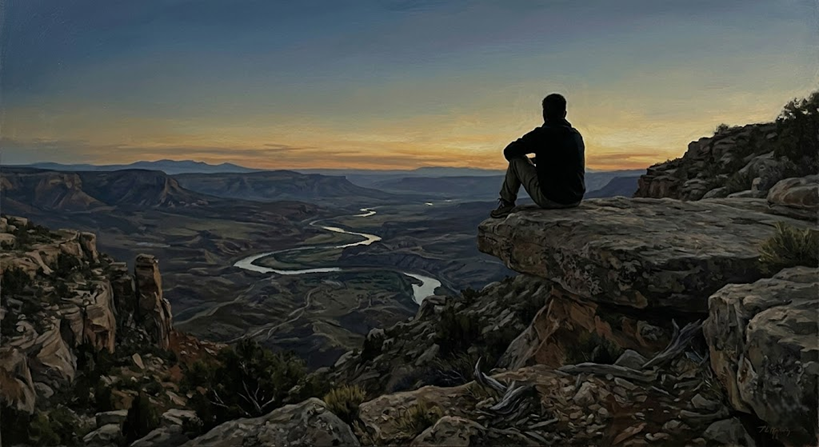
(Image Description and Credit: A lone figure sits in quiet stillness on a high rock at dusk, hands open, overlooking a vast valley — settled, not defeated. Image generated with Google Gemini.)