When God Restores
Ruth Ann Stites, Staff Writer
Some years ago, I read my way through Patrick O’Brian’s Aubrey-Maturin series of novelsbeginning with Master and Commander. The serieschronicles the careers of two British officers in the early 1800’s. Richard Snow in his cover story for the New York Times Book Review (January 6, 1991) called the series “the best historical novels ever written.”[1] Fascinating as these books are in bringing to life the era of the Napoleonic Wars, the thing that has stuck with me is the use of naval jargon, not for itself, but as a reflection of naval influence on the English language. Over and over, I’d say to myself, so that’s where that word or phrase came from! Some examples are overwhelm, aloof, taken aback, clean slate, and by and large. [2] Since England, an island nation, relied heavily on the sea in trade, warfare, and exploration this is hardly surprising, but all that borrowing of nautical terms reminds us of the sense of power, fear, and fascination with the sea humans have long experienced. It should come as no surprise that the imagery for chaos and order is rich in water references.
In our last post we looked at chaos versus order to better understand the meaning of refuge. One of the great, reoccurring symbols for both chaos and order is water. From Genesis to Revelation water provides imagery for the transformation of chaos into order. In Genesis the chaotic, watery depths are brought into order to share in the good creation along with “the great creatures of the sea” (Gen. 1:10, 21). God finished His creation with humanity, and all of it He called “good,” a paradisial “cosmos.”[3] But in the order of this Paradise lay fallow the seeds of the chaotic fall as described in Genesis 3.
Life had turned into a painful existence in a hostile, cursed world. The blessed cosmos of Paradise had turned into chaos, not the original chaos of Genesis 1:2 but now an evil chaotic world: struggles between animals and animals (Gen 3:14, cf. Isa 11:6), between animals and humans (Gen 3:15), between husband and wife (Gen 3:12, 16), between nature and humans (Gen 3:17-19), and between humans and God (Gen 3:8-10, 12, 22-24). And it all ends in death–an ultimate form of chaos.[4]
Through the following millennia of Biblical history water depicts chaos as in the Noahic flood (Gen. 6:9-9:17), the trek of Israel through the Red Sea (Exod. 14), the storms and sea monsters depicted in the Psalms (Ps. 69:1-2; 65:7; 74:13-14), and in the Prophets (Isa. 8:7-8; 17:12; Jonah 2:3-5). In the New Testament Jesus uses water imagery to highlight the power of chaos in our world when we ignore His teaching as in the Sermon on the Mount (the house built on sand Matthew 7:26-27). He demonstrates His power over chaos when He walks on water and quiets the sea with a phrase (Matt. 8:23-27; Mark 4:35-41; Luke 8:22-25).
The images of water as order are also richly abundant in the Scripture. In Habakkuk 3:8 the prophet shows God’s divine sovereignty, His complete mastery over the chaotic sea. In Isaiah 43:2 God protects His people when they “pass through the waters.” Isaiah also uses water imagery in how the Lord will guide the faithful, “and you shall be like a watered garden, like a spring of water, whose waters do not fail” (Isa. 58:11b). In Ezekiel 47:1-12, the prophet envisioned the great and ordered, life-giving river flowing from the Temple. That same imagery is picked up in the river of life in the Book of Revelation (Rev. 22:1-2).
Jesus also uses water imagery for the ordered, Godly life, especially in John, first with the woman at the well (John 4:14) and later speaking to the crowd in Jerusalem at the Feast of Booths, “On the last day of the feast, the great day, Jesus stood up and cried out, ‘If anyone thirsts, let him come to me and drink. Whoever believes in me, as the Scripture has said, ‘Out of his heart will flow rivers of living water’” (John 7:37-38).
When we pray, let us remember that we find refuge from chaos and its fearful storms and enter a realm of order with its life-giving, delightful waters, when we approach the Heavenly throne. In Psalm 46:4 we are told “There is a river whose streams make glad the city of God, the holy habitation of the Most High.” That fits well with words from another Psalm, “They feast on the abundance of your house, and you give them drink from the river of your delights. For with you is the fountain of life; in your light do we see light” (Ps. 36:8-9). We come “to a place of quiet rest, near to the heart of God.”[5] Chaos flees and the Master of order is present when we pray.
Reflection Questions:
1. What are some of the examples of water imagery of both chaos and order that comes to your mind? How do these deepen your understanding of God’s order overcoming the chaotic evil you encounter in our world?
2. While water is a powerful descriptive tool for the psalmist in Psalm 46, the same imagery is used elsewhere in Scripture. What are some of your favorite examples? Does this discussion of water imagery add new depths to your favorite passages.
3. I find it interesting that the Bible uses water imagery to describe both chaos and order. What do you think are some of the reasons this dual imagery is used? How does this deepen your understanding of God’s work and purpose in your life?
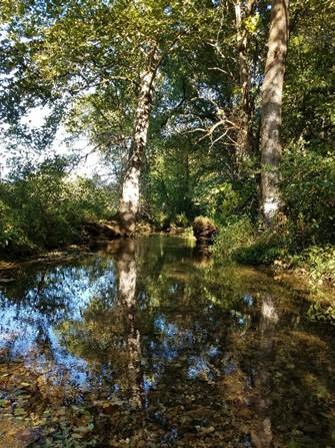
(Photo description and credit: One of the great water images in the Bible is of God’s people being like a tree planted beside still waters. This picture captures that imagery. Credit: R.A. Stites, from a low water bridge on Sugar Creek Road in Benton County, AR.)
[1] Quote from Wikipedia article on Aubrey-Maturin series.
[2] A link to my Google search for nautical terms in English and their influence on English.
[3] 10 Things You Should Know about Chaos and Cosmos in God’s Creation | Crossway
[4] Ibid.
[5] Line from the hymn “Near to the Heart of God” written by Cleland McAfee.