Being Faithful
Ruth Ann Stites, Staff Writer
Over 150 years ago on Sunday, September 18, 1870, members of the Washburn-Langford-Doane Expedition entered the Upper Geyser Basin in what would become Yellowstone National Park.[1] The first geyser they saw would be christened “Old Faithful.” In his 1871 account of the expedition for Scribner’s, Nathaniel P. Langford would write, “It spouted at regular intervals nine times during our stay, the columns of boiling water being thrown from ninety to one hundred and twenty-five feet at each discharge, which lasted from fifteen to twenty minutes. We gave it the name of “Old Faithful.”[2]
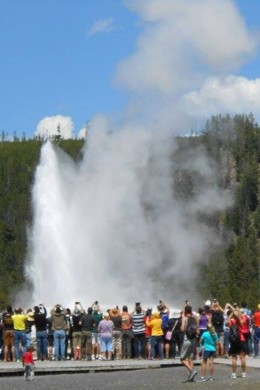
Today, on average, Old Faithful erupts every 92 minutes. It is a spectacular sight as up to 8,400 gallons of boiling water form a plume of steam over 100 feet high.[3] As the crowd gathers and excitement builds, one of the most recognizable features of Yellowstone performs reliably year after year.
While the predictability of Yellowstone’s Old Faithful is a natural wonder, an even more magnificent example of faithfulness is found in its Creator, the Lord God Himself. The thread of faithfulness is woven through Scripture as a characteristic of God. It is His very nature to be faithful. Verses like Numbers 23:19, Deuteronomy 7:9, Psalm 36:5, Lamentations 3:22-23, and II Timothy 2:13 illustrate this point.
The importance of God’s faithfulness to prayer is clear when Paul says, “God is faithful, who has called you into fellowship with his Son, Jesus Christ our Lord” (I Cor. 1:9). We have, this verse tells us, been called into fellowship with His Son by a faithful God. Since prayer is a pivotal point in that ongoing relationship building between us, we can be assured that the faithfulness of God is always at work as we pray.
One of the great, dramatic scenes of Genesis is God affirming His covenant with Abram (Gen. 15). In the language and symbolism of political alliances, where “…a sovereign state, a regional superpower would enter into a covenant with a vassal state,” God enters into a relationship with Abram and the nation he would father.[4] For our prayer life, the importance lies in the relative strengths of the parties. The stronger, God, makes a pact with the weaker, us, that, because of who He is, will stand indefinitely.
When we pray, we are coming before the throne of grace where sits the ultimate sovereign of all creation. In Malachi chapter 3 the Lord, through His prophet, speaks of covenant breaking and covenant keeping. One telling sentence says, “I the Lord do not change” (v. 3). The idea of His constancy is repeated in Hebrews 4. Here, by the work of our High Priest Jesus, we are invited to come before that throne knowing He who sits upon it is faithful:
Therefore, since we have a great high priest who has ascended into heaven, Jesus the Son of God, let us hold firmly to the faith we profess. For we do not have a high priest who is unable to empathize with our weaknesses, but we have one who has been tempted in every way, just as we are—yet he did not sin. Let us then approach God’s throne of grace with confidence, so that we may receive mercy and find grace to help us in our time of need. Hebrews 4:14-16
Knowing that He is faithful, that we are invited to come, and that we can be confident that He will hear us should encourage us to come…daily!
Reflection Questions:
- What are some examples of faithfulness that have impressed you? How do these help you deepen your understanding of God’s faithfulness?
- Does the assurance of Biblical texts that God is faithful influence you to be bold in approaching Him in prayer? Why (or why not) is this true?
- Paul in Ephesians 5:1-2 encourages his readers to imitate God and His Son Jesus. What are some ways to follow their example of faithfulness? List some areas you want to be more faithful in imitation of Christ. If you need some inspiration, refer to the rest of this passage, Ephesians 5:3-20.
(Photo description and credit: I took this shot of Old Faithful while on vacation with my family, R.A. Stites, 2016.)
[1] Yellowstone, the world’s first national park, was established in 1872Yellowstone National Park (U.S. National Park Service)
[3] Ibid.