
Inspiration for Discipline
Ruth Ann Stites, Staff Writer
There was a great deal of turmoil in the United States in 1943. Our country was fully mobilized to fight WWII on the battlefield in both the European and Pacific theaters, at home with long hours of work in critical war industries making us the Arsenal of Democracy, and by the sacrifices of the public as rationing was enforced to conserve resources for the war effort. WWII had solidified America’s role as a global superpower. As if hostilities abroad were not sufficient, racial tensions erupted coast to coast from the Zoot Suit Riots in Los Angeles in June to a race riot in Harlem that August. It was the year that John F. Kennedy’s patrol boat, the PT-109, was sunk, the Pentagon (the world’s largest office building) was dedicated, and Duke Ellington played at Carnegie Hall for the first time.
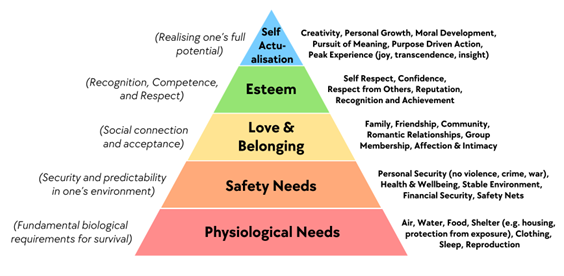
It also marked the first publication of Professor Abraham Maslow’s influential hierarchy of needs illustrated by an iconic pyramid. This seminal article introduced a spectrum of human needs from the basic, Physiological, to the highest, Self-actualization.[1] Although more nuanced than when first presented, it remains a mainstay of psychological understanding about the needs that drive people to act as they do, especially in the fields of business management, education, and healthcare.
In Maslow’s classic pyramid, at the bottom are our Physiological Needs, “fundamental biological requirements for survival,” including such things as air, water, food, and shelter.[2] Next comes our concerns for Safety Needs, “security and predictability in one’s environment,” meaning everything from dealing with a war to financial security. The third level of the pyramid is Loving and Belonging, “social connection and acceptance,” and is about family and community connections. Above this the fourth level, Esteem, is about “recognition, competence, and respect,” dealing with confidence, reputation, recognition, and achievement. The final level, Self Actualization, “realizing one’s full potential,” deals with our drive toward creativity, morality, and purpose. It is at this level that we seek transcendence and joy.
The complexity of human nature quickly outgrows the simplicity of the original pyramid Maslow wrote about in 1943, but it offers an insight into the prayer life of King David exemplified in Psalm 5. This is David’s “Morning Prayer.” This is where he started his day. This is the discipline that sustained the man and the king. While David does not address each area of need directly, they are all there. He must be sustained physically if he is to pray each morning, “In the morning I lay my requests before you” (verse 3). He addresses safety needs openly in his prayer, “Hear my cry for help” (verse 2). Community saturates his anthems of praise as he and his people face each day, “But let all who take refuge in you” (verse 11). He knows the privilege of esteem, “But I, by your great love, can come into your house” (verse 7). And, finally, he addresses those self-actualization needs as he rejoices with his people, “Let them ever sing for joy…that those who love your name may rejoice in you. Surely, Lord, you bless the righteous; you surround them with your favor as with a shield” (verse 11-12).
Consider how the habit of daily prayer addresses the full spectrum of your needs. Think about starting each day with a time of prayerful reflection addressing the most basic and the most sublime desires you hold. That is what Psalm 5 offers, an extremely practical cry for help set in the framework of the most transcendent worship, praise, and rejoicing. While the details of the challenges you face will no doubt differ from those of a king who ruled millennia ago, the human heartbeat of need, longing, hope, and joy remain the same as does the answer…daily prayer with all our needs on display to the God who loves us.[RF1]
Reflection Questions:
- Psalm 5 is a “morning prayer.” The idea of greeting the morning in prayer is very ancient. In Genesis 19 we find a reference to Abraham having a place of prayer in the morning, “Early the next morning Abraham got up and returned to the place where he had stood before the Lord” (verse 27). Over the millennia morning prayer became, first, an expected part of Jewish religious practice and, later, of Christian practice. What are some of the reasons praying to start the day is beneficial? Does knowing the practice’s deep roots change your view of making morning prayer a habit?
- While there are many types of prayer—adoration and praise, confession, petition, intercession, consecration for example—have you ever considered a totality of needs prayer? Do you think this is a model of praying with these in mind that could help you develop a deeper discipline of prayer? If not, what would help you develop this discipline?
- Remember using rote prayer is as valid as using extemporaneous prayer…after all the Psalms are prayers you can recite and meditate on even if they were written so long ago. Look for resources you can employ to develop the discipline of prayer. What new inspiration did you find?
In case you are interested in crafting prayer around the hierarchy of needs, the following illustration may be helpful:
[Photo description and credit: I took this shot as a dad and his two young sons were practicing skipping a stone across the water. Dad was very good at it, getting several skips at a time. The boys were just starting to learn and sunk more rocks than they skipped. Just like stone skipping on a pond, prayer is a discipline we can develop until it becomes natural and effortless. Taken by R. A. Stites at Mount Hebron Park in Rogers, AR.]
[1] Maslow’s hierarchy of needs – Wikipedia
[2] Quotes from the graphic noted as second photo in the photo credits.