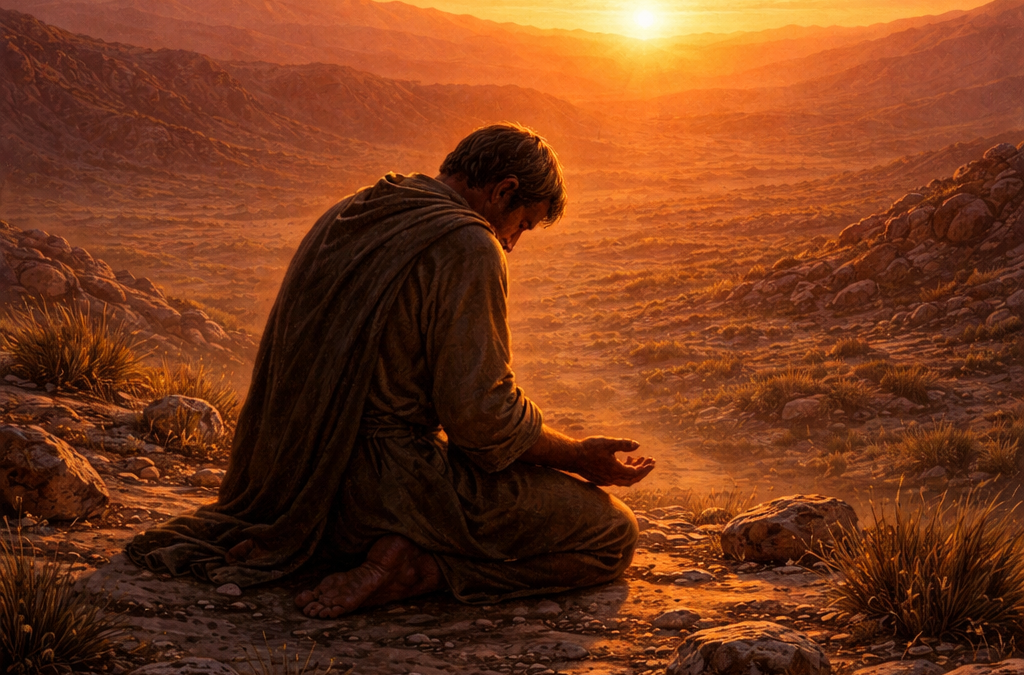
Morning Prayer (Psalm 5)
Michael Floyd, Editor
Listen to my words, Lord,
    consider my lament.
Hear my cry for help,
    my King and my God,
    for to you I pray.

In the morning, Lord, you hear my voice;
    in the morning I lay my requests before you
    and wait expectantly.
For you are not a God who is pleased with wickedness;
    with you, evil people are not welcome.
The arrogant cannot stand
    in your presence.
You hate all who do wrong;
    you destroy those who tell lies.
The bloodthirsty and deceitful
    you, Lord, detest.
But I, by your great love,
    can come into your house;
in reverence I bow down
    toward your holy temple.

Lead me, Lord, in your righteousness
    because of my enemies—
    make your way straight before me.
Not a word from their mouth can be trusted;
    their heart is filled with malice.
Their throat is an open grave;
    with their tongues they tell lies.
Declare them guilty, O God!
    Let their intrigues be their downfall.
Banish them for their many sins,
    for they have rebelled against you.
But let all who take refuge in you be glad;
    let them ever sing for joy.
Spread your protection over them,
    that those who love your name may rejoice in you.

Surely, Lord, you bless the righteous;
    you surround them with your favor as with a shield. -- Psalm 5
What fills your mind in those first moments after waking? For most of us, the day rushes in fast — responsibilities, worries, the mental checklist assembling before our feet hit the floor. David knew the feeling. Yet he built his life around one daily discipline: before the world spoke to him, he spoke to God. Psalm 5 is a morning prayer — urgent, honest, and utterly dependent.
“In the morning, LORD, you hear my voice; in the morning I lay my requests before you and wait expectantly.” Verse 3 is the heartbeat of this psalm. David isn’t describing an occasional, when-I-feel-like-it prayer. He is describing a rhythm — a daily act of reorientation that shapes everything that follows.
Notice the phrase “wait expectantly.” David doesn’t dump his requests before God and rush off to manage the day himself. He lays them down and waits. Morning prayer, for David, is not a spiritual transaction. It is an act of trust. By waiting, he is saying: I cannot navigate today alone. I need You to move first. That kind of surrender is harder than it sounds — and it is the very essence of genuine communion with God.
The psalm shifts quickly to something that might catch us off guard: stark language about God and wickedness. God is not pleased with wickedness. The arrogant cannot stand in His presence. This is not a threat; it is an honest description of God’s holy nature — and it clarifies everything about prayer.
We don’t approach God as spiritual equals who have earned an audience. We come as needy people with no standing before a holy God on our own. But that recognition is meant to drive us straight to verse 7, the pivotal turn at the psalm’s center: “But I, by your great love, can come into your house.” The door is not open because of who we are. It is open because of who God is — and that changes everything about how we pray.
“Lead me, LORD, in your righteousness because of my enemies — make your way straight before me.” This is the practical heart of David’s morning prayer. Before the day unfolds and confusion sets in, he asks God to make the path clear. He knows his own wisdom isn’t enough.
You may not face David’s kind of enemies, but every day brings its own opposition — voices that mislead, pressures that distort, moments when the right way forward is far from obvious. Morning prayer is how we submit those uncertainties to God before they overwhelm us. David ends the psalm not in anxiety but in quiet assurance: “You surround them with your favor as with a shield.” The day that begins with God ends under His protection.
The One Who Prayed Before Us
Long after David wrote this psalm, Jesus lived it perfectly. Mark 1:35 tells us that very early in the morning, while it was still dark, Jesus rose and went to a solitary place to pray. Morning prayer was not a duty He maintained — it was the breath of His communion with the Father. He showed us what complete dependence on God looks like.
But there is something even deeper at work here. Verse 7 opens a door: “But I, by your great love, can come into your house.” The great love David trusted in advance is the love fully revealed at the cross. Jesus absorbed the holy judgment against sin described in verses 4 through 6, so that we could enter God’s presence by grace, not merit. He is our righteousness (1 Corinthians 1:30). He makes our way straight. And because He ever lives to intercede for us (Hebrews 7:25), our morning prayers rise to the Father through a Mediator who never sleeps and never stops interceding on our behalf.
Living It Out
Morning prayer doesn’t have to be elaborate. It doesn’t require a quiet house, an hour set aside, or the perfect words. What it requires is willingness — to give God the first word before the news, the phone, or the weight of the day settles in. Lay your requests before Him. Wait expectantly. Ask Him to make your way straight. Then walk into your day under the shield of His favor, knowing that the God who heard David’s morning voice hears yours.
Questions for Reflection
- What typically gets your attention first in the morning — your phone, your worries, the news, or God? What does your morning routine reveal about your actual priorities? What would it look like, practically, to give God the first moments of your day?
- David asks God to “make your way straight before me” before he knows what the day holds. How often do you seek God’s direction before making decisions, rather than after? Is there a situation right now where you have been relying on your own wisdom rather than seeking God’s guidance first?
- Verse 7 says David entered God’s house “by your great love,” not by his own goodness. Do you tend to approach God with confidence in His grace, or do you feel you must earn your way into His presence? How does knowing that Christ is your righteousness change the way you come to God?
- David “waits expectantly” after laying his requests before God. What does waiting on God actually look like in your daily life? Does your prayer leave room for God to respond, or is it mostly you doing the talking?
[Image description and credit: A lone figure kneels on a Judean hillside at dawn, hands open in prayer as golden sunrise light breaks over the horizon. Generated by ChatGPT.]