An Invitation to Inefficiency
Rosa Floyd, Guest Writer
 I’m in a season of life where caregiving is my daily reality – yet again. The Lord seems to find caregiving a good place to plant me to learn deep lessons. Not surprising, given Paul’s words to children and grandchildren:
“but if any widow has children or grandchildren, they must first learn to practice piety in regard to their own family and to make some return to their parents; for this is acceptable in the sight of God.” (1 Timothy 5:4 NASB95)
I’ve been in hard caregiving situations before but this one is landing differently – these are my beloved parents who have loved me so well and so unconditionally my entire life. I want to do this well, so I’ve been reading some books around the topic of caregiving. One of them intrigued me by its very title: Real Love for Real Life: The Art and Work of Caring by Andi Ashworth.
One of the over-arching principles that jumped out to me as a new idea was Ashworth’s statement that “Caregiving by its very nature is inefficient.” She gave numerous examples to which I could quickly relate: Helping an elderly person dress, convincing someone with dementia to take their medication, the painstaking process of walking with a walker.
As I read this book, I sensed God asking me to receive something very different from Him than I’ve ever received before: An invitation to love inefficiently. My parents are not impressed with the speed at which I can handle a visit and the associated needs that arise. They are not moved by my well-crafted to-do list, checked off with yellow highlighters that give me a sense of accomplishment. They fundamentally do not need my efficiency. They need my presence.
As I processed this gift – and it is a gift, though at times it feels dubious – I thought of the inefficiency of Jesus. He was always going off the pray when there was ministry to be done, calling His disciples to talk when the crowds pressed in, throwing out challenging messages that send the majority of the crowd away just as His popularity was surging. And then there’s this model of inefficiency:
“Now when Jesus learned that the Pharisees had heard that Jesus was making and baptizing more disciples than John (although Jesus himself did not baptize, but only his disciples), he left Judea and departed again for Galilee. And he had to pass through Samaria. So he came to a town of Samaria called Sychar, near the field that Jacob had given to his son Joseph. Jacob’s well was there; so Jesus, wearied as he was from his journey, was sitting beside the well. It was about the sixth hour. A woman from Samaria came to draw water. Jesus said to her, ‘Give me a drink.’” (John 4:1-7 ESV)
Although scholars disagree on the precise reason Jesus chose this route, it is clear that Jerusalem to Sychar was around 44 miles and a 9000-foot elevation change – no wonder He was tired from the journey! His conversation with the woman at the well shows He didn’t go the most direct route in discussion to make His point. Instead, He asked questions, drew her out, and allowed her to engage in genuine dialogue with Him. In a word, His inefficient approach made her feel seen. We see the impact of this approach in her later witness to others:
“So the woman left her water jar and went away into town and said to the people, ‘Come, see a man who told me all that I ever did. Can this be the Christ?’” (John 4:28-29 ESV)
As I have learned to receive the gift of an invitation to inefficiency, I’m learning that when I slow down, look my parents in the eye, give them time to formulate questions, linger just a little longer at the table after lunch, I am giving them a gift far more precious than the tasks I still must do for them. I am giving them the gift of being seen.
Is God inviting you into your own space of inefficiency? Who are you not seeing because your eyes are on your calendar or checklist? Take a lesson from Jesus. Embrace opportunities to love inefficiently.
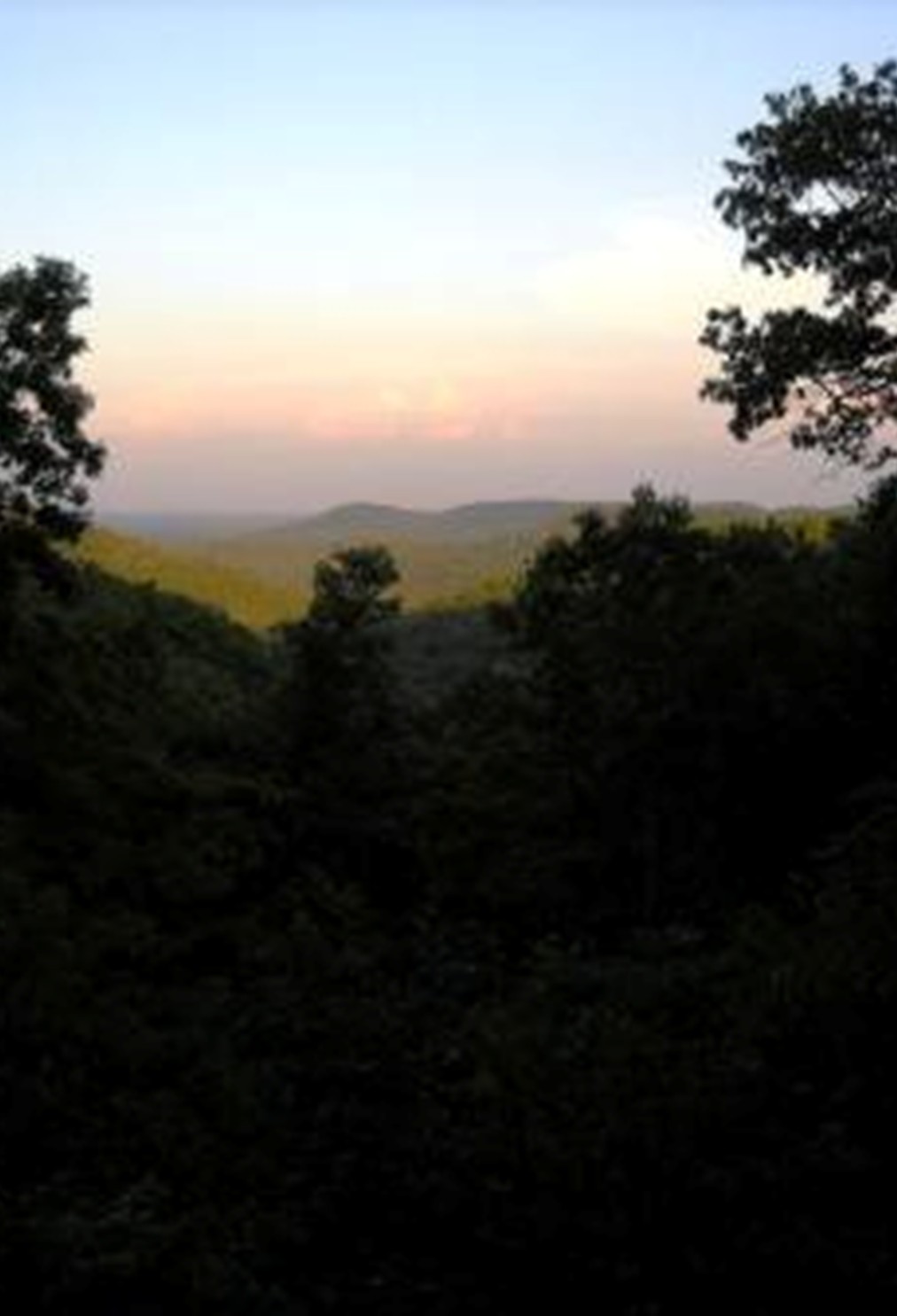
We chose the picture for this week’s post to illustrate the slow and seemingly inefficient natural processes that sculpt our environment.
(Photo credit: R. A. Stites, overlook on highway into Missouri’s Roaring River State Park)