Trust is a Verb
Ruth Ann Stites, Staff Writer
Before I understood the powerful story behind the movie, I fell in love with the “Chariots of Fire” theme song for the 1981 Oscar winning film of the same name. But, as appealing as the music and the movie are, Eric Liddell’s full life story is far more winsome. Born to Scottish missionary parents in Tianjin, China on January 16, 1902, he spent his first five years there. When he was six and his brother Robert was eight, their parents brought them to England to enroll them in Eltham College, London, a boarding school for sons of missionaries. Their parents returned to China but came home on furlough a few times during their school years when the family usually lived in Edinburgh. During his years at Eltham, Eric’s sporting prowess earned him the Blackheath Cup as best athlete of his year among other recognitions.
In 1920 Eric joined Robert at the University of Edinburgh where his award-winning sporting career continued. Eric earned fame as a rugby player for, first, the University Club and later for the international rugby union of Scotland. He was inducted into the Scottish Rugby Hall of Fame in 2022 on the centenary of his first international cap against France. Twenty years earlier, in 2002, when the Scottish Sports Hall of Fame inducted its first members, Eric Liddell “topped the public vote for the most popular sporting hero Scotland had ever produced.”[1]
He also excelled in running in his college years including a record setting 100-yard win in the 1923 AAA Championships that would not be equaled for 23 years. The following year Eric Liddell would win a gold medal for the 400-meter race in the 1924 Summer Olympics in Paris, France.
Following his graduation from college in 1924, he began preparations for returning to China as a missionary by attending the Scottish Congregational College in Edinburgh for a year. During his studies he was chosen as a spokesman for the Glasgow Students’ Evangelistic Union. He spoke to meetings in Scotland, from smaller groups to large crowds, about his Christian faith, as he had done since his university days.
At the end of his training he set out for China with the London Missionary Society, the same group his parents had worked for, where he taught chemistry and English at an Anglo-Chinese college in Tianjin. Being a devoted athlete he also helped train boys in various sports. He would continue to teach, coach young athletes, and compete himself until World War II changed everything.
On a furlough home to Scotland in 1932 Eric was ordained as a Congregational minister. Back in China he and Florence Mackenzie married in 1934. She was born in China, the child of Canadian missionary parents, and trained as a nurse in Canada. The couple worked side by side serving the Chinese people as teacher and nurse. They had three daughters, Patricia, Heather, and Maureen. Her father would never meet the youngest, Maureen who was born in 1942, since the family evacuated to Canada in late 1941 shortly before the Japanese attack on Pearl Harbor as the British government and their missionary agency advised.[2]
Eric stayed to help the people. After his family left, he and his brother Robert, a doctor, traveled to a rural mission station in Xiaozhang, where he stayed until the Japanese closed it. He returned to Tianjin until he and other missionaries were confined to a civilian concentration camp in Shandong province. While not brutalized and forced to work as military prisoners were, the civilians were crowded into a small compound with “very little privacy, poor sanitation and acute shortages of everyday goods. Hunger was a constant factor, with not enough food or variety in the diet to provide anything but the most basic level of sustenance.”[3] His attitude and actions as he lived out his faith in these difficult conditions “proved his real worth.”[4]
With his health compromised by conditions in the camp, more troubling symptoms emerged as Eric began to suffer from headaches and memory loss. This was followed by a series of strokes. He finally fell into a coma and died on February 21, 1945. Subsequently it was discovered that he had suffered from an inoperable brain tumor no doubt complicated by the rigors of life in the camp.[5]
One of the most dramatic moments of Eric Liddell’s Olympic performance was his refusal to compete in qualifying heats for his best event, the 100-meter sprint, on a Sunday. Thus, he was disqualified. Instead, he ran the 200-meter race, winning a bronze medal, and the much longer 400-meter race. Of course, Eric won that race with a time of 47.6 seconds, an Olympic and World Record, and a gold medal.
To make such a conscience driven decision to keep the Sabbath holy demonstrated his trust in the Lord. He sought to live out his faith in accordance with verses like this from I Samuel, “But now the Lord declares: ‘Far be it from me! Those who honor me I will honor, but those who despise me will be disdained’” (I Sam. 2:30b). In his own words, Eric said, “You will know as much of God, and only as much of God, as you are willing to put into practice.”[6]
Trusting another person implies a relationship where you are certain that he or she has your best interests at heart, values you, and is consistent in their reliability. In biblical terms it means having full confidence in God’s character, power, and promises. Faith is usually used as a noun as in Hebrews 11:1, “Now faith is confidence in what we hope for and assurance about what we do not see.” But trust is a verb where we are actively demonstrating our faith through obedience, submission, and reliance on Him as shown in Proverbs 3:5-6, “Trust in the Lord with all your heart and lean not on your own understanding; in all your ways submit to him, and he will make your paths straight.”[7] Simply put, faith is what you have and trust is what you do with it.
Of course, one of the things we should accomplish in actively trusting the Lord is pray. To perform the act of prayer, trusting we are heard and heeded, has several aspects. We need to be honest about our hopes, our doubts, and our fears; to wait on God’s answers; be willing to follow His direction rather than our plans; and focus on God’s character. Psalm 121 is especially eloquent on this last point. The first two verses make it clear that the only source of help God’s people have is Him. “I lift up my eyes to the mountains—where does my help come from? My help comes from the Lord, the Maker of heaven and earth.” None of the deities who laid claim to the high places of worship in Israel had the ability to help (remember Elijah on Mount Carmel in I Kings 18-20). The only help the Israelites could depend upon came from the Lord. The rest of the psalm is devoted to the character and actions of God that clearly show He is trustworthy. Knowing that God watches, is not taken by surprise because He is otherwise engaged, and pays attention to “your coming and going both now and forevermore” (v. 8) should not only reassure us of His trustworthiness but offers praise to the God who is trustworthy. Sometimes all we need is to remind ourselves that He is trustworthy and praise Him for being so.
Reflection Questions:
1. Eric Liddell is a wonderful example of Christian commitment in the 20th century. Do you have other heroes of the faith you can point to whose lives inspire you to Christian living?
2. Have you thought of trust as the active expression of faith before? Does doing so change your outlook? Why or why not?
3. What are some ways you can incorporate examples of God’s trustworthiness in your devotional and prayer time? How does knowing we can trust God change our viewpoint in challenging times? Do you have examples of this principle at work?
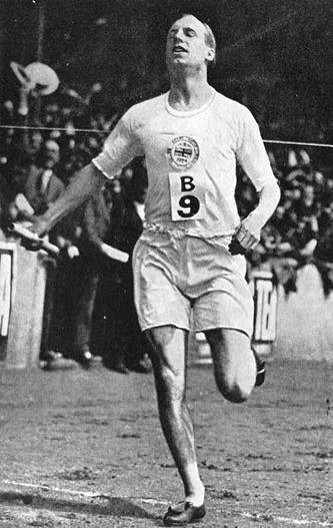
(Photo description and credit: Eric Liddell at the British Empire versus United States of America (Relays) meet held at Stamford Bridge, London on Sat 19 July 1924). Credit: http://lewishamlegacy.wdfiles.com/local–files/eric-liddell/EricLiddell.jpg)
[1] About Eric Liddell – The Eric Liddell Community
[2] Japan invaded the Chinese region of Manchuria in 1931. By 1937 the Second Sino-Japanese War marked what historians widely consider the beginning of WWII in Asia, and on December 7 of 1941 they would attack Pearl Harbor.
[3] Eric Liddell Part 2: Life Away after the Olympics- Guest post by Neil Bettridge – Voyager of History
[4] Ibid.
[5] In addition to the sources already cited, some other interesting websites about Eric Liddell’s life are: From Gold Medalist to God’s Missionary – C.S. Lewis Institute, Eric Liddell – Wikipedia, Eric Liddell – the life of an athletics legend – Scottish Athletics, The Liddell Family of Missionaries.
[6] Seven-Lessons-from-the-Life-of-Eric-Liddell.pdf
[7] Other trust verses include Psalm 56:3-4, Psalm 62:8, Isaiah 26:3-4, Jeremiah 17:7-8, and Romans 8:28.