Our Mighty Fortress is a Person
Ruth Ann Stites, Staff Writer
When you think of a revolutionary, a scholar may not be the first person to come to mind. Yet one of the most revolutionary figures in European history was a cleric and university professor. His name? Martin Luther. He was a man of many talents: Augustinian monk, professor, reformer, theologian, musician, hymnwriter, and poet.[1]
Among his revolutionary ideas was universal literacy. Luther promoted literacy both in the written language and in music. Not only was reading to be taught to the populus so they could read the Bible for themselves, but they were to become singers of holy songs rather than only listen to the performances of others. He espoused “community singing” and the education of the congregation to be able to participate: “Schools or parishes became responsible for vocal training….”[2]
One of his great and familiar hymns is “A Mighty Fortress is our God.”[3] The first verse is:
A mighty fortress is our God,
a bulwark never failing;
our helper he, amid the flood
of mortal ills prevailing.
For still our ancient foe
does seek to work us woe;
his craft and power are great,
and armed with cruel hate,
on earth is not his equal.
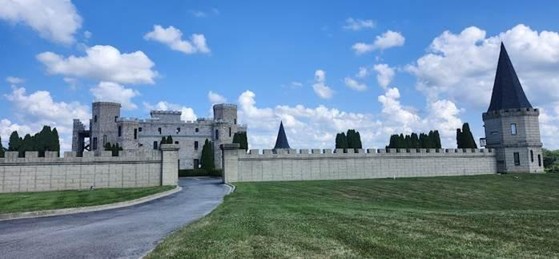
Luther called God our fortress. But what is a fortress? The image that immediately comes to my mind is a Medieval castle.[4] Following the Norman conquest of England, King William began constructing castles across his new holdings. His first purpose was to “Defend conquered territories from attack.”[5] The second was closely related, to deal with civil unrest. As the kingdom became more secure, not only did stone replace the original wood structures, but the other major roles of a castle became more apparent, “…as a centre [1] for local government, administration and justice. They were also used by powerful lords to display their wealth and power through lavish architectural styles and decoration.”[6]
Psalm 46 refers to God as both fortress and refuge. As such, He, like a Medieval castle, protects and defends the people tied to Him; provides justice, security, and order; and displays the “pomp and circumstance” of the Sovereign.[7] For those who seek safety in the Lord, there will also be the rule of justice well administered and, harking back to Psalm 27, our focus in April, the rejoicing and delight of worship in “the house of the Lord.”
In the first verse from “A Mighty Fortress…” Luther also introduces the enemy as our “ancient foe.” It is important that we know who he is. Holocaust survivor Corrie Ten Boom, said, “The first step on the way to victory is to recognize the enemy.”[8] And the Apostle Paul identifies the enemy we are to confront thus, “… take your stand against the devil’s schemes. For our struggle is not against flesh and blood, but against the rulers, against the authorities, against the powers of this dark world and against the spiritual forces of evil in the heavenly realms” (Eph. 6:11b-12).
Paul describes the armor God provides for His people in Ephesians 6:10-20. Its purpose is to allow us to “…take your stand against the devil’s schemes” (Eph. 6:11b). Armed and ready for battle we leave the refuge of the fortress of God and sortie forth to battle knowing the fortress is always waiting our return.[9] Paul goes on to provide the chief tactical weapon of spiritual warfare, “And pray in the Spirit on all occasions with all kinds of prayers and requests. With this in mind, be alert and always keep on praying for all the Lord’s people” (Eph. 6:18).
As Psalm 46 tells us our refuge is unassailable (v. 1-2), He is our refuge (v. 7), and His victory is assured (v. 10). Get in the battle using your weapon of prayer and remember the Lord Jesus’s words, “These things I have spoken unto you, that in me ye might have peace. In the world ye shall have tribulation: but be of good cheer; I have overcome the world” (John 16:33, KJV).
Reflection Questions:
1. What is your favorite image of a fortress? How does your understanding of it improve your understanding of what it means that God is our fortress?
2. Does thinking about your life circumstances change when you take shelter in His mighty and unassailable fortress? Do you make use of your refuge in “the God of Jacob” regularly?
3. Have you contemplated prayer as an offensive weapon, a tactical advantage in spiritual warfare? Why or why not? Do you have examples from your life of using prayer as a weapon against evil as Paul describes in Ephesians 6:12? (Photo description and credit: On a vacation trip to Kentucky in 2025 I took this photo of The Kentucky Castle Hotel in Versailles. It is one of the best “fortresses” I’ve visited and photographed. Credit: R. A. Stites)
[1]This is not a typo but the English spelling of the word. The quote is from a website in Great Britian.